A dazzling literary detective story

Dostoevsky, it must be said, was no saint. He was famously cantankerous; he had at least one affair during his unhappy first marriage; he was also ruinously addicted to roulette. But he had a brilliant mind, at ease with contradiction, and was determined to use literature to pursue the moral consequences of the ideas that defined his era. To do so, Dostoevsky took inspiration from the real life story of Pierre-François Lacenaire, a charismatic gentleman murderer whose trial had been the talk of Parisian society in the 1830s, fashioning the bones of his life into one of literature’s most compelling sinners: Raskolnikov, the protagonist of Crime and Punishmenta handsome, clever and often kind university student who nonetheless murders two defenceless old women with an axe.

The novel set Russian society ablaze on publication, with reviewers recognising it as a work of “unrivalled importance” written “with a truthfulness that shakes the soul”. (It was also prophetic: in late January 1866, just when the first chapters were being readied for publication, a law student named Danilov committed an almost identical crime.) But Crime and Punishment was no ordinary whodunnit. Instead, the book has been called a “whydunnit”, since the reader witnesses Raskolnikov’s crime in vivid detail almost immediately after the novel is under way. Throughout the story, there is a fatalistic sense that Raskolnikov cannot resist his guilt; if he is not caught, he will confess. The real question is: why? Even the murderer sometimes seems at a loss to explain his actions, and we sense that the final answer will expose the moral workings of his whole generation, who have fallen into the trap of utilitarianism, determined to found peaceful utopias by violent means.

We sense the answer will expose the moral workings of his generation who have fallen into the trap of utilitarianism

For modern readers, of course, a third question hovers behind the novel: how did Dostoevsky create a work of such ferocious conviction, whose impact was so immediate and marked? How could this man, who had fallen foul of the authorities but never for any violent crime, have published a novel that asks us to spend so much time inside the mind of a murderer? And can we ever account for works of genius, that so often appear to have sprung into the world fully formed? These are the central preoccupations of marvellous “howdunnit” The Sinner and the Saint by Kevin Birmingham, which intertwines the story of Raskolnikov’s conception with the life of his real life double, Lacenaire. It is the second book by Birmingham, whose 2014 cultural history of Ulysses was a New York Times bestseller and won the PEN New England and Truman Capote literary awards.

We first meet Dostoevsky starving in Wiesbaden, having gambled away all his money, writing frantic begging letters to friends, acquaintances and ex-lovers to pay off a hotel bill. His wife and older brother had recently died within months of each other, leaving Dostoevsky with crippling debts from the literary journal the brothers had started together. What was meant to be a relaxing writing trip had now turned into a harrowing attempt to avoid arrest. To distract himself from starvation he scribbled frantically in his notebook, hoping to write his way out of debt.

Remarkably, this wasn’t the absolute nadir of his life. Fifteen years earlier, at the age of 28, he had been subjected to the trauma of a mock execution before being sent to Siberia, a weeks-long journey in cold so severe that it could make people’s eyes congeal and encase their mouth and nose in ice. His crime had been to fall in with a group of free-thinking writers, some of whom were unwise enough to criticise the tsar, others of whom were even plotting revolution. He spent almost a decade in exile before returning to St Petersburg determined to stage his literary comeback.

Dostoevsky first read about Lacenaire in late 1860 while hunting for material for Vremyathe aforementioned journal. The 32-page account of Lacenaire’s trial he stumbled upon came accompanied by evocative engravings: the murderer well dressed in his top hat, cravat and high collar; someone about to swing an axe; the incongruous detail that Lacenaire had received a good education and wrote poetry. The author of the account speculated that Lacenaire had succumbed to the “ferocious materialism” and “egoism” of the day (referring to the radically amoral doctrine of German writer Max Stirner, whose ideas also inspired Nikolai Chernyshevsky, the hero of the Russian radicals). In his editorial note on the Russian translation he commissioned, Dostoevsky wrote that accounts of criminal trials like this are “more exciting than all possible novels because they light up the dark sides of the human soul that art does not like to approach”. In focusing on Crime and Punishment, The Sinner and the Saint necessarily misses revealing insights from elsewhere in Dostoevsky’s copious work. For instance, one of the purest expressions of egoism is Prince Valkovsky of The Insulted and Injured (“All is for me, and the whole world is created for me … And the more virtuous an act is, the more egoism there is in it. Love yourself – that’s the only rule that I recognise”.) Equally, because the narrative concludes with Dostoevsky’s marriage to his second wife, Anna, we miss the final 13 years. The couple will be exiled by debt and gambling in Europe, have four children and lose two of them, and Dostoevsky will develop his themes further in his three other acknowledged masterpieces, The IdiotDemons and The Brothers Karamazov. But that is outside the scope of Birmingham’s study, and it would be hard to fault the book on its own terms.

Meticulously piecing together the debates that fired Dostoevsky’s imagination, The Sinner and the Saint is filled with arresting details that bring the turbulence of the 1860s to life, such as the government officials, fearful of the youth, who “forced nihilist women to sign pledges that they would grow their hair long and wear crinolines”, or the radical writer, Pisarev, who enjoyed the enforced contemplation of solitary confinement so much he turned up to interrogations looking “as though he had somehow just arrived from a ball”.

Birmingham traces the evolution of Crime and Punishment through Dostoevsky’s notebooks, offering a thrilling glimpse of the creative faculties at work as he tweaks dialogue, defers the resolution of Raskolnikov’s motivations, and adds in unexpected twists. As we approach the end of The Sinner and the Saintand Raskolnikov begins to live and breathe in all his complexity, Lacenaire begins to seem less and less interesting by comparison, a strangely two-dimensional narcissist who revels in the knowledge that his public was “captivated by my latest capers” and wants to wear his blue frock coat to the guillotine.

But it would be a mistake to read the title as referring to Lacenaire the Sinner, and Dostoevsky the Saint. Rather, each of us has the capacity for goodness and for cruelty. It is this fundamental insight by which Dostoevsky elevates the story of Lacenaire the unrepentant murderer into Raskolnikov the divided heart, who “might murder not because he was so evil but because he … wants to do good”, and whose actions turn out to be a mystery even to himself. Published 200 years after Dostoevsky was born, The Sinner and the Saint is not just a fitting tribute to one of the great works of world literature, but a dazzling literary detective story in its own right.

This review of The Sinner and the Saint by Kevin Birmingham was originally published in the Guardian. As you can tell, I loved it. For my own book on Dostoevsky, look here.
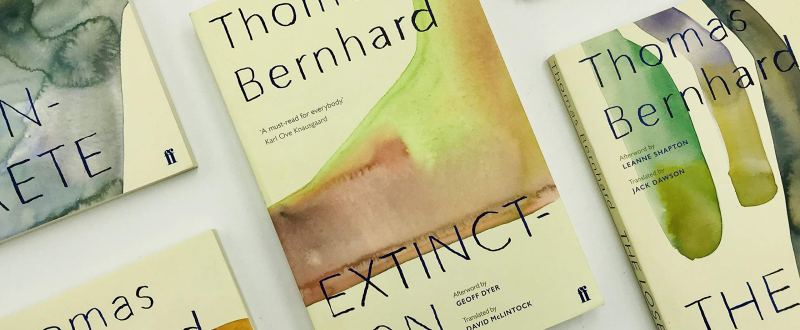
Whining into the void

This year, Faber is reissuing five novels by Thomas Bernhard, who rose to fame as a thorn in the side of the Austrian establishment, though he comes down to us as “Austria’s finest postwar writer”, in the words of Gabriel Josipovici. The first two of these reissues, Concrete (1982) and Extinction (1986), were released in March, with beautiful abstract watercolour covers by Leanne Shapton. The latter, with its exponential curve, looks as if it might represent a Malthusian catastrophe, or perhaps, with its meaty pinkness shading into green, a sliver of prosciutto on the turn; the former is a diffusion of blue paint, its almost iridescent quality promising something rather more colourful than concrete.

The two books come with afterwords by Geoff Dyer and Michael Hofmann respectively, as well as starry-eyed endorsements including the New York Times’s claim that Bernhard’s novels are “the most significant literary achievement since WWII”. And yet even his fans are quick to issue caveats. John Updike commented on the “hostility” of Bernhard’s walls of unparagraphed text; Dyer calls his work “fundamentally unapproachable” but finds that readers nonetheless end up dragged out to sea in “the implacable riptide of Bernhardian woe”. Hofmann writes that you can’t really prepare for “Bernhard’s machined vehemence, though once you’ve read one, you perhaps start to crave the bitter taste and the savage not-quite-humour”.

It is impossible to understand the Bernhardian landscape without knowing something of his life. Born in Amsterdam to a single mother, he was moved at a young age to Salzburg, where he was placed in a Nazi home for boys. After the war, the home rebranded itself as a Roman Catholic institution. “Fundamentally”, Bernhard writes in his memoir, Gathering Evidence, “there was no difference between the National Socialist System and the Catholic system. Everything simply had a different veneer and a different name, but in the end the effect was the same.” He had ambitions to be a singer, but he caught a lung infection while unloading potatoes from a cart in the snow at the age of seventeen, and never fully recovered.

And so Bernhard’s narrators are about as happy-go-lucky as Arthur Schopenhauer; indeed, a character from his second novel, Gargoyles, actually eats pages from The World as Will and Representation. They excoriate Austria for its collaborationism and refuse to take part in society. They also declare that they must be heard even when they aren’t sure what to say. They find themselves lost in the petty shallows of everyday consciousness. They are the nephews of Franz Kafka and Knut Hamsun, the grandchildren of Dostoevsky’s Underground Man, with whom there are many parallels. Liberated from work by an inheritance, the archetypal Bernhardian narrator makes an art of his own idleness; rather than draw one sure line, he sketches over the same point repeatedly; he turns out aphorisms as provocations; he blames others for his own inability to foster relationships.

Concrete, the shorter and earlier of the two novels reissued this spring, charts the narrator Rudolf’s procrastinations as he prepares to begin writing a book about “Mendelssohn Bartholdy”. Almost everyone remarks on the musicality of Bernhard’s style: he deals in the subtle weaving of phrases and motifs and repetitions (though it’s worth saying that there’s little to be gained by studying his superstructures). Never, for example, do we hear the German composer referred to as “Felix Mendelssohn”, nor as “Mendelssohn” – only ever “Mendelssohn Bartholdy”. The phrase, repeated over and over, begins to take on the power of an incantation.

Paralysed by his aspirations and the weight of his research, Rudolf vituperates his sister for preventing him from beginning, but, having decided to get away from the family home to write in Mallorca, realizes that he can’t write there, either. The most fruitful of these procrastinations turns out to be Concrete itself. It is a novel of yearning, of distraction, of falling short. We learn that Rudolf is stuck after ten years on the first sentence, just like Joseph Grand in Albert Camus’s novel The Plague – and little wonder, since the first sentence of Rudolf’s notes is a twelve-line knot of clauses and qualifications.

If the Rudolf of the earlier novel sometimes has a fogeyish bluster, Franz Josef Murau, the narrator of Bernhard’s last novel, Extinction, is a pure-bred misanthrope. Condescending, supercilious, misogynistic, hypocritical, this Ancient Mariner won’t let you go until he has told you everything he can’t stand about his childhood. He berates Austria for its enthusiastic embrace of Nazism and Catholicism, but he sees no problem with living in Rome; he says he is an intellectual but all he does is bitch and gossip. He detests the tasteless, the depraved, the petit-bourgeois, architects, builders, doctors, the obese, animals and writers, especially those who write what he calls “binder literature”: the literature of bureaucrats.

The novel begins with a telegram informing Murau of the death of his parents and brother, leaving him, the prodigal son, as heir of the family estate at Wolfsegg. In the book’s extended metaphor, Wolfsegg is Austria; Murau’s childhood playroom there, the site of his fondest memories, was squatted by Nazis during the war; and the estate’s huntsmen stand in for the country’s military. For half the novel, Murau sits looking at three photographs – of his parents, of his sisters, and of his brother – turning over the reasons why he dislikes them. In the second half, he goes back to Wolfsegg to dislike the surviving sisters in person and to take possession of the estate.

Murau is not likeable; he’s barely bearable. There is something adolescent about his invocation of the intelligentsia (Wolfsegg doesn’t just have a library, it has five) and his name-dropping of famous hotels. The biggest problem is his relative lack of irony compared to a narrator like Rudolf, whose bile is offset by his sheepish awareness of his own weakness and anxiety, his concession that his sister wants what is best for him, his occasional admission of fault. Rudolf is his own worst enemy, where Murau is simply cruel and unreasonable. George Steiner wrote that “too often, notably in his later writings, Bernhard succumbed to a monotone of hate”, and Extinction has all the tonal variation of a fridge. Or to put it more politely, this may not be entry-level Bernhard.

That said, there is something strikingly modern, even prescient, about the targets of Bernhard’s trollish excess. Take Rudolf’s excoriation of dogs and dog owners in Concrete, for instance: “I’ve always hated dogs. . . . Those with the very basest of souls keep dogs, allowing themselves to be tyrannized and finally ruined by their dogs. . . . The masses are in favour of dogs because in their heart of hearts they are not prepared to incur the strenuous effort of being alone with themselves, an effort which in fact calls for greatness of soul”. Or Murau’s apoplexy over photography: “Everybody wants to appear happy, never unhappy, to project a falsified image, never a true image of the unhappy person he is. . . . It never strikes them how appallingly they compromise themselves”. He later clarifies that since the invention of photography “the mental condition of the human race has been in permanent decline”. It seems fair to assume that he would have judged the Europe of 2019 extremely cursed.

I suspect much else is forgiven if you find him funny. Dyer claims Bernhard has written “the funniest passage in the whole of literature”, though perhaps Murau has taught him to exaggerate (“I’ve cultivated the art of exaggeration to such a pitch that I can call myself the greatest exponent of the art that I know of”). The humour of distortion to absurdity or grotesque is funny if you don’t secretly suspect that he means it. But as Bernhard put it in an interview in 1981, “I need not invent anything. Reality is far worse”. By his last novel, Bernhard appears animated by the sincere belief that there is no future, and the world he paints is fundamentally hostile and degenerate. “The only advice I can offer to any thinking person is to kill himself before the millennium. . . . That’s my genuine conviction”, offers Murau towards the end of Extinction. Thomas Bernhard died by assisted suicide in 1989, after years of deteriorating health; the rest of us had the stupidity to outlive him.


This review was first published in the Autumn 2019 issue of the Brixton Review of Books. You can get four issues for £10 here.