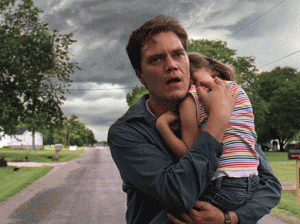
Survival guides always sell well in the USA. Perhaps it is part of the frontier mentality: one man, possibly holding a gun, protecting his family and his patch of soil. Or perhaps it is the Protestant obsession with linear narratives that end in a day of reckoning. Whatever it is, the idea that an honest US citizen might one day have to fend for himself, abandoned to the forces of nature immediately and without warning, is a persistent one.
In case you missed it, the current global financial crisis has repeatedly been referred to as a “perfect storm.” The storm metaphor is also evoked when talking about troubling mental disorders, as in the expression “black clouds,” used to describe depression. Put the three together, and you’ve got an American blockbuster movie.
In Take Shelter, one honest US citizen, who may or may not be mentally ill, is worrying about money, and about whether a massive storm is going to come and wipe out his family. The storm may be literal or metaphorical, the manifestation of a mental illness or a terrifying act of God. To hear the conceit, you could be forgiven for thinking that the film was going to be a bit trite, like one of those big-budget apocalypse films where New York taxis are flung into the Hudson and improbably strong children cling to lampposts. But, from the trailer, the film looked more pensive and brooding than all that, so I sat back and waited to be convinced.
In the first shot, Curtis (Michael Shannon) stares out at a gathering storm. It looks like a real bastard of a storm: grey, sullen, unpredictable. The rain starts up heavily, lashing his face. We jump cut to Curtis in the shower. From that moment on, this is the theatre of battle. We are definitely watching a storm, and we don’t know whether it is Curtis turning on the tap. It’s a tension that plays out quietly, in unsettling increments.
Curtis is having terrible nightmares, but he doesn’t want to alarm his wife or daughter—his mother was diagnosed with paranoia at around the same age, and perhaps it really is nothing. Soon, the nightmares are troubling him deeply, affecting his work and home life, and his obsession with renovating the storm shelter out back is taking up ever more time and money. The heartbreaking paradox is that we don’t know whether, in trying to protect his family, he is really harming them further.
This is not a dialogue-heavy screenplay, but there’s enough talk to bring out some remarkable acting. Michael Shannon can glare in a way I haven’t seen since Ray Liotta, but he uses his arsenal sparingly, giving us a Curtis that is occasionally menacing, but often all too human, agonised, conscientious, trying his utmost to be self-contained. Jessica Chastain’s performance is assured, and their relationship with each other becomes very moving as you are drawn into their situation and the film builds towards its climax.
Take Shelter has been widely praised in the US, where it is already being hailed as a masterpiece. The film has failed to impress critics in the same way in the UK, but this is a very American film, tied up with concerns and a frame of reference that are American. We don’t live in a place where we lose our healthcare if we lose our job, and none of us (except the truly unhinged?) have even considered owning a storm shelter. But, on its own terms, it is a quietly affecting film that avoids blockbuster cliché and carefully builds to a powerful conclusion.

 Alex Christofi