Gimme shelter

Survival guides always sell well in the USA. Perhaps it is part of the frontier mentality: one man, possibly holding a gun, protecting his family and his patch of soil. Or perhaps it is the Protestant obsession with linear narratives that end in a day of reckoning. Whatever it is, the idea that an honest US citizen might one day have to fend for himself, abandoned to the forces of nature immediately and without warning, is a persistent one.

In case you missed it, the current global financial crisis has repeatedly been referred to as a “perfect storm.” The storm metaphor is also evoked when talking about troubling mental disorders, as in the expression “black clouds,” used to describe depression. Put the three together, and you’ve got an American blockbuster movie.

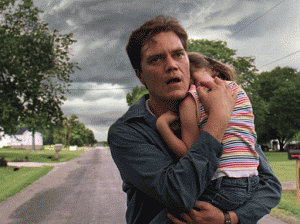
In Take Shelter, one honest US citizen, who may or may not be mentally ill, is worrying about money, and about whether a massive storm is going to come and wipe out his family. The storm may be literal or metaphorical, the manifestation of a mental illness or a terrifying act of God. To hear the conceit, you could be forgiven for thinking that the film was going to be a bit trite, like one of those big-budget apocalypse films where New York taxis are flung into the Hudson and improbably strong children cling to lampposts. But, from the trailer, the film looked more pensive and brooding than all that, so I sat back and waited to be convinced.

In the first shot, Curtis (Michael Shannon) stares out at a gathering storm. It looks like a real bastard of a storm: grey, sullen, unpredictable. The rain starts up heavily, lashing his face. We jump cut to Curtis in the shower. From that moment on, this is the theatre of battle. We are definitely watching a storm, and we don’t know whether it is Curtis turning on the tap. It’s a tension that plays out quietly, in unsettling increments.

Curtis is having terrible nightmares, but he doesn’t want to alarm his wife or daughter—his mother was diagnosed with paranoia at around the same age, and perhaps it really is nothing. Soon, the nightmares are troubling him deeply, affecting his work and home life, and his obsession with renovating the storm shelter out back is taking up ever more time and money. The heartbreaking paradox is that we don’t know whether, in trying to protect his family, he is really harming them further.

This is not a dialogue-heavy screenplay, but there’s enough talk to bring out some remarkable acting. Michael Shannon can glare in a way I haven’t seen since Ray Liotta, but he uses his arsenal sparingly, giving us a Curtis that is occasionally menacing, but often all too human, agonised, conscientious, trying his utmost to be self-contained. Jessica Chastain’s performance is assured, and their relationship with each other becomes very moving as you are drawn into their situation and the film builds towards its climax.

Take Shelter has been widely praised in the US, where it is already being hailed as a masterpiece. The film has failed to impress critics in the same way in the UK, but this is a very American film, tied up with concerns and a frame of reference that are American. We don’t live in a place where we lose our healthcare if we lose our job, and none of us (except the truly unhinged?) have even considered owning a storm shelter. But, on its own terms, it is a quietly affecting film that avoids blockbuster cliché and carefully builds to a powerful conclusion.

The Pajama Men and other laughs

Once again, everyone has gathered in Edinburgh for the Festival Fringe, the world’s largest arts festival, bringing together some of the world’s greatest comedians. There are thousands of shows on, and I’m not going to pretend that I’ve seen them all, as that would be physically impossible. Many of the shows on offer are bad, but I’m not going to waste words wittily degrading the vaudevillian try-hards and morph-suit-wearing teenagers that litter the Royal Mile. Here a few of my favourite comedy acts from this year’s Fringe.

Matt Forde – (Dis)honourable Member

If I had to choose from a list of topics that I don’t find entertaining, politics and sport would sit quite high up the list. But with blue eyes and a gradually reddening face, Forde spins incredibly funny yarns from his own experience of working for TalkSport and the Labour party, revealing his ill-fated meeting with John Motson, his strangely successful years as an Alan Partridge impersonator and Mandelson’s unpredictably sexual charisma, all building to a satisfying crescendo. I only wish he had been doing stand-up four years ago, so that we might have benefited from his insight at the time.

Sheeps

These Footlights alumni have returned with a three-man sketch show, embracing silliness whilst lampooning some of the stranger follies of the modern world by means of an insecure rapper, a dubious correspondence course diploma and footballers advertising raisin mash. Apart from a derivative satellite-delay sketch, they are original and surprising, toying with silences to marvellous effect in sketches such as their creepy game show, What’s In My Pocket?

The Pajama Men: In the Middle of No One

These two men (pictured above) are partially insane, or very good at pretending to be. Their show tells a number of intertwined stories, but frankly I didn’t care what the story was, because their performance was just so eminently watchable. Hailing from America (hence the odd spelling of pyjama), they switch between multiple characters with an astonishing vocal and physical dexterity and an unimpeachable sense of timing. In fact, they’re such good performers that you could almost lose sight of how good their script is, throwing up dozens of perfect gags (my favourite being, ‘Dear diary: I miss you’). This is comedy at its very best.

Holly Walsh – The Hollycopter

It is illegal to jump off Worthing Pier, but it is not illegal to fly off it. And that’s just what Holly Walsh did, or attempted to do, a year ago, in the Bognor Birdman competition. Armed with a powerpoint presentation containing photos, footage and Venn diagrams, Walsh tells the story of how she found herself falling 40 foot in a homemade helicopter. Generous about others and deprecating about herself, Walsh has bags of charm. Her list of Things To Do Before I Die had me in stitches, and her storytelling was so natural that I left feeling almost as if she was a friend I had known for years.

Totally Tom

This sketch duo comprises Tom Palmer and Tom Stourton, creators of the YouTube series High Renaissance Man. They are at their best exploring social awkwardness, as when they introduce the show as jaunty club reps, but they are equally at home taking apart the conventions of Shakespearian theatre. One particularly dark sketch involves a dead-eyed striptease act, accompanied by the callow jeering of a compere. These two know the value of a guilty laugh, and they tear it out of you whether you like it or not.

A good long play

I was lucky enough to get a free ticket to see a dress rehearsal of Sam Mendes’s Richard III previewing at the Old Vic last weekend, as I’ve been doing a small project with their new writing programme. I was looking forward to it, though there were rumours going round that they were performing pretty much the full text. Let’s just establish that this is not something that one should approach lightly. It is Shakespeare’s second longest play (behind Hamlet), and what’s more, a lot of the text is taken up with useful but not utterly gripping details: who has got their troops over near Wales; who has formed an alliance with who; all of the complicated blood lines that connect the royal characters, etc.

When I got to the theatre, I was told that the play would run for three and a half hours. The situation was as grave as I had expected, and the fifteen minute interval would allow only enough time to beat my way through the crowd for a quick gulp of fresh air before fighting my way back to my seat. I heard others talking about the length with some trepidation, and one, glancing longingly down at their smartphone, mentioned leaving in the interval.

But we were wrong to moan, for two reasons. Firstly, it is a wonderful play and a wonderful production. When the lights went down and Kevin Spacey limped on stage, some audience members may have been tempted to shout out, ‘Keyser Söze!’ But Spacey is a brilliant theatre actor, with a limitless ability to make you sit up and pay attention—and that was what we did. He was the perfect Richard, charming, funny and cynical, his camaraderie with the audience only making his ruthlessness more chilling, because you found yourself willing him on. In fact, the whole cast were brilliant, on top of which, the set provided elegant, simple solutions to the text. The sound design was a little heavy-handed, and I couldn’t quite bring myself to believe in Gemma Jones’s old-bag-lady Margaret, cursing with bones and sand—I think words are probably enough—but it was a really engaging piece of entertainment.

Which brings me to the second reason it is wrong to worry about the length of the play. It’s this: there is actually nothing wrong with a long play. The idea that we as an audience might get bored after one hour of theatre has somehow taken hold, presumably on the basis that the internet is making us inattentive and computer games are making us egocentric and fast food is making us dizzy. This is not true. If I needed any proof of the general public’s ability to maintain interest, I might point out that most of my friends have watched whole DVD box sets in one sitting, and some are even prepared to sit through all 681 excruciating minutes of the Lord of the Rings films.

The worst thing is when a theatre company decides that Shakespeare didn’t know what he was doing and cuts random chunks out of a text. Richard III or Hamlet are not easy plays to stage, but it is the dramatist’s responsibility to find ways of making them engaging. It shouldn’t be a question of how much time you are taking out of a person’s day, but instead whether it feels worth it. If it is long, so what? The whole point of theatre is that it takes you out of the world for a little while.

Unless you’re planning on restaging Peter Brook’s nine-hour Mahabharata, then, the paradigm should not be whether you can chop a play down to suit a bored audience, but whether you might entertain them sufficiently that they want to come back after the interval to find out what happens. Theatre can be a vital, spontaneous kind of art, and patronising it by assuming that your audience must have come by mistake and must be held without interval, or that they might not understand some scenes in a Shakespeare play, doesn’t serve anyone’s best interests. The brave thing to do is what Sam Mendes has done, making concessions to clarity where necessary, but giving his audience the gift of the whole play in its rich, cruel splendour.