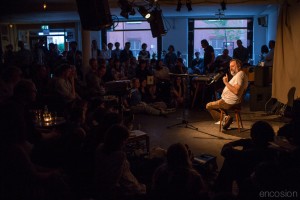
It is Friday night, and in a café down a little side street in Dalston, the hipster capital of London, a strange event is taking place. Intellectuals, radicals and assorted others are gathering for the launch of Slavoj Žižek’s magnum opus, Less Than Nothing, a 1200-page tome on Hegel and the long shadow of dialectical materialism.
My hand is stamped, so that I am permitted to re-enter, because this event will last for 24 hours. There will be an introductory talk on Hegel for beginners at 6.30pm, followed by a talk by Žižek at 8pm, and then a non-stop reading of Less Than Nothing will begin at 11pm, starting from the first page, with volunteer readers taking the microphone in 15 minute slots throughout the night. Broken only by a couple of related film screenings, the readings will continue through to 6pm the next day. The barstaff are working three sets of eight-hour shifts, and the doorman is only paid until 7am, after which any pugnacious cultural theorists will have to sort out their own differences. Only the book’s publicist is booked in for the full 24 hours, but I am determined to last the night at least.
I find a seat where my view is not obstructed by a pillar and sit down next to a pretty young woman, who tells me her name is Anna. She has taken two degrees since moving from Brazil, one in fashion, the other in psychoanalysis. I ask her whether she is one of the Žižek faithful, and she says that she’s never read any of his books, but she did see him on a panel about Greece. And he was so good you had to see him again?
“Well, he said some crap,” she explains. But she’s still here, so he must have sparked something in her.
Half a beer into the evening, every seat is occupied and there’s barely room to stand. Dr Iain Hamilton Grant comes on to give the introductory lecture—a wise move, if Anna and I are anything to go by. He explains a bit about Hegel’s Phenomenology of Spirit, about the conception of Geist, and quotes a neat phrase which I resolve to memorise for future occasions when I want to be obnoxious at dinner parties: “knowing is unemployed in the familiar.” I love that idea. Not only do we skip over what is familiar to us, but in that sense we cease really to know it. I dread to think how many times I have taken the same route to my office in the morning, but if you were enough of a Philistine to ask me whether there was a Starbucks on the way, I’m not sure I could tell you.
* * *
7.45pm. About an hour in to Dr Grant’s lecture, a bald geezer stands up. “Can someone tell me what he just said?” he shouts. The room is silent, so he expands: “Do any of you have any idea what he’s talking about? Honestly?”
An affronted man near the stage sits up. “Yes,” he replies loudly.
“Go on then,” says the geezer. “Explain it to me.”
“What, you want me to explain the whole thing? Won’t that be a bit time consuming?” says Affronted Man.
“Summarise,” challenges geezer.
Affronted Man explains, lucidly, that we are not separate from the world, that our thoughts are not mirrors which reflect the world but a part of it, inextricable from the things we perceive. He earns a round of applause from the audience, and I can’t help feeling that it speaks of gratitude that their self-elected spokesperson should be so articulate against this impostor, where others might have faltered, or worse still, been totally unable to explain the foundations of the Hegelian philosophy of mind.
I decide to take a brief break after all the excitement, before Žižek is to take the floor. I go to the bar to get another beer, and find myself standing next to the man himself. For a man who has declared himself a “monster,” he is not very imposing. He isn’t wildly unkempt, nor overcome by his trademark sniffing and gesticulatory frenzy. He’s a little shorter than average, with brushed hair and a clean white t-shirt, his shoulders slightly rolled, for all the world looking like a man who hopes not to be recognised. When I encounter him, he is trying to pay for a cookie at the bar, even though the publicist is insisting it is free. One cannot help but be endeared to the man.
I return to my seat and a pensioner-Marx, with his white cloud of a beard, is arguing vocally with the bald geezer, tussling over the right to call themselves Marxists. The conversation appears to have strayed from Hegel somewhat.
“Workers need concrete ideas, not abstractions!” shouts the bald man. I think I hear someone boo. I look over to the other side of the stage, where Žižek has now, unfortunately, been recognised, and is rocking gently from side to side surrounded by doe-eyed disciples.
He is introduced to whoops and hollers, and opens with a familiar refrain: “What do you expect?” I worry that Žižek suffers from a perennial and self-inflicted problem—that he appeals to a wide variety of people for very different reasons, and that none of them ever forgive him for refusing to speak only to them. Nonetheless, he opens his talk in an admirably Hegelian fashion by trying to marry the two apparent extremes that have opened up in his audience, between the abstract and concrete. He points to the microphone, which someone has wisely equipped with a pop filter. For Marx and Hegel, he explains, the microphone is not “concrete”; it, too, is an abstraction. It is endlessly mediated, by developments in technology, the mining of metals, popular music.
Onstage, Žižek is magnetic. Constantly returning to phrases like “you know,” “of course,” “that famous story,” “and so on,” he gives the listener the impression that he really believes you know as much as him. He also knows his audience, raising the roof with a reference to a recent Guardian article which recounted his son making an oral sex joke, and eliciting knowing titters with references to Jacques Lacan, who crops up in every talk he has ever made. Many of his pronouncements border on observational comedy. Try agreeing, he suggests, when someone says their parents are jerks.
Later, he talks of an “evil experiment” he performed on his son, about whom he has spoken several times this evening with guileless fascination. Žižek approached him with a mask on and the son was freaked out. “But it is only me,” he said, taking off the mask. Then Žižek put the mask back on, and approached his son again, and even though he knew who was behind the mask, his son was still freaked out. And suddenly, during a joke about his strange parenting approach, I am finding myself quite convinced of his contention that we reduce ourselves to social roles, that our sentiments are a lie, that to ask who is behind the mask is to miss the point. I had thought I was laughing at him, but he has turned it around. “Your inner life is a joke,” he tells the audience, serious now. “It doesn’t matter what you think. It is what you do, and say, that matters.”
The bald man stands to interrupt once more. Žižek accepts the challenge to cheers, and they discuss the crisis of the left, the coming Greek elections, workers’ strikes. Žižek points out that most strikes nowadays are the preserve of the enfranchised: policemen, teachers, and so on, who are striking precisely in order to avoid re-joining the proletariat. He has only heard of one proletarian strike recently in Slovenia, where, ironically, workers were fighting for their factory to declare bankruptcy. They haven’t been paid in six or seven months; at least if the factory was declared bankrupt, they would qualify for the dole. And once they are unemployed, they will join the new class of “unemployable” that has recently come into existence. There is much to fix.
But he is adamant that Hegel is not irrelevant. Marx returned to Hegel in critical moments, as did Lenin. “Don’t be ashamed of theory,” he entreats. The whole talk, he has been staring out at the crowd as if unable to fix on a single face, and as he takes questions he explains that he has twilight myopia, making him unable to see anything in the dark.
* * *
11pm. After Žižek has left, some of the crowd leaves too—Anna, pensioner-Marx, Dr Iain Hamilton-Grant—leaving the fans to the serious business of worship. Soon, it will be time to begin the recitation of Less Than Nothing, in an uninterrupted block throughout the night and out the other side of the day, punctuated only by a couple of film showings on Saturday.
I take the opportunity to track down the bald man, to ask him for his version of events, and chat to him on a bench outside, where the streetlamps are now on, and the cool breeze carries away some of the sweat from our faces. I tell him that he seems to know what he thinks about Žižek already, and, not to put words in his mouth, he doesn’t seem to like him. So why did he think he should come?
“The thing is, Žižek is a major figure. He portrays himself as a Marxist, and I think he’s a charlatan really.” His name is Paul, and he’s a member of the International Committee of the Fourth International World Socialist website. “What all these people ignore is, Marx explained the crisis of capitalism, you know, and now everyone is saying, well, Marx is right.” But he’s worried that, with theorists like Žižek about, the workers’ revolution he wants won’t come about, and they won’t be able to attract the young people who are looking for something to believe in. Presumably they’ll all be too busy hunkering down with their Hegel.
Back inside, someone new has taken to the stage, and is doing a pretty convincing Žižek impression. He is talking about the difference between a moron, an idiot, an imbecile and a “becile,” and it’s quite funny. He has captured the way that Žižek speaks, and that hobbyhorsical way that he teases out meanings. I wonder how long it took him to write the words. I have been admiring his pastiche for a few minutes when I realise he is actually the first reader, and is holding a copy of Less Than Nothing, open at page two. I am reminded of one of Žižek’s favourite Marx Brothers jokes: “You look like Emanuel Ravelli.” “But I am Emanuel Ravelli.” “Then no wonder you look like him!”
* * *
A little after midnight. The woman who is now reading has a dedicated audience of four, but the room is still full. Most people are talking animatedly in groups, and the reader looks almost as if she is reading to pass a test, like a girl at a Bat Mitzvah.
I introduce myself to a guy called Bod with very long hair and a girl called Charlotte with very short hair. Both are architects. We talk a little about theory. Someone in the Q&A had voiced a concern that Žižek was much clearer in person than he was on the page. “I don’t find him very easy to read, and I’m saying that as someone who’s read Deleuze,” says Charlotte. “Deleuze is easier to follow.”
We are joined by a man named Matthew—splendid in leather jacket, boots, newsboy cap and moustache (think Glenn Hughes from The Village People). Matthew couldn’t get into the main talk, but he’s turned up now the crowd has thinned out. He’s signed up to read at 2.45am. I tell them that I’ve been wondering how many people here tonight have read much of Žižek’s work. Matthew seems to know his stuff; Bod says that he hasn’t really read any, but he loves the perspective that he gets from the more accessible references the philosopher makes.
There’s a great section in Žižek’sThe Sublime Object of Ideology about the Hitchcock film Rear Window. In the film, wheelchair-bound James Stewart has grown obsessed with snooping on his neighbour’s apartment. Stewart’s girlfriend Grace Kelly can’t seem to get his attention, and it is only when she goes to the neighbouring apartment and enters the frame that James Stewart really sees her again. This seems to be the way Žižek himself works for most people. His readers claim to have honourable intentions towards understanding his cultural theory, but really we’re all waiting for that moment when he turns his attention on something we are already interested in. Leading figures on the political left meet with him regularly, with people like Alexis Tsipras of Greek party Syriza involving him in their discussions. Film students love the Pervert’s Guide to Cinema. We all know he’s a genius. We’re just waiting for him to come into our frame.
I take a deep breath. I am about to put myself on the line. “I think,” I say tentatively, “that basically, even amongst his fans, not that many people understand all the stuff about Hegel.”
A man I haven’t spoken to before leans in. “I have a PhD in Hegel,” he says.
“Sorry—of course I’m generalising…” I backtrack.
“But I wouldn’t say I understand Hegel,” he replies.
* * *
2.30am. The crowd is consolidating to its hard core. I am at the bar with Matthew, who is telling me about a caffeine drink, Club Mate (pronounced “mart-eh”), which he says is very hard to get hold of outside of Berlin. I buy a bottle. It tastes like a cross between iced tea and Super-Malt. In a good way. One of the groups near the stage has caused a minor fire by putting paper in the candle on their table. It flares up, and for a moment everyone pauses, before the flame ebbs and the reading continues. We are not even 10 per cent through the book.
It’s Matthew’s turn next, and I wish him luck. I wonder what it would be like to read it out loud—whether many readers feel like a Sybil, channelling the words rather than consciously processing them at the speed one reads aloud. But he seems to be doing an admirable job, and stays on longer than his allotted time to fill a brief gap in the schedule.
“So what was it like?” I ask him afterwards.
He takes a slug of Club Mate. “It is hard reading that shit.”
Did it feel like a long time to be reading something so dense?
“No, actually it felt very short, I could go another half hour or so, I enjoyed it. But it’s very strange because you get immediately thrown into it. I mean, I have no idea what the fuck hypotheses 1, 2, 3, 4 are, but then he talks about hypotheses 5 and 6 and you’re just like, okay I’m gonna go with this. I’ve read a fair amount of Hegel, I’ve read a fair amount of Lacan, I’ve read some of Zizek. So I could understand what I was reading.”
Later, I ask another reader the same question, and he confesses that he had no idea what was going on, but that he was glad he gave it a shot. A small part of me is jealous that I didn’t make myself go up there.
* * *
4am. There are perhaps ten of us in the room. Someone shouts, to no-one and without apparent cause, “Does communism have Twitter?” No one seems to react. I am certain that this just happened. However, I have been running for nearly two hours solely on Club Mate, and on beer for the eight hours previous, and I am very, very tired. On top of which, the last five hours or so have been accompanied, not by music, as is traditional in a late night bar, but by pages and pages of phrases like “undead partial object.” The current reader accidentally says the word “nob,” and we all laugh hysterically. It is a good word.
* * *
5am, and it is bright outside. Matthew is lying supine on the floor, his newsboy cap pulled over his face. He told me he was going to try and cycle home, but then he got really drunk. I lick my raw lips and look around the room. The barman and the doorman both look asleep. The publicist is hugging a pillow. A reader is reading. But there are still perhaps eight audience members present, one of whom has been patiently following the reading with a pencil and his own copy of Less Than Nothing all night. And we few who remain, we happy few, have witnessed something tonight.
I decide that I have to leave, in that stubborn binary way that decisions are made when drunk and tired. Some of those present might try to stay for the next 12 hours, too, but I have had my fill. I am leaving convinced that Žižek is indeed a genius, but perhaps a little wistful that my own experience of his intelligence has always to be mediated through films that I know, and politics. Concrete things, as Paul might say.
And whilst all the Žižek was interesting, so too were the audience. In a Midnight in Paris kind of way, I’ve always felt that it was a shame I was never alive during the 1950s, when I could have wandered into Café de Flore any day of the week and found students debating heatedly with Sartre and de Beauvoir, with Miles Davis and Juliette Greco sharing a private joke in the corner. But Café Oto in Dalston will do for now. I have been invited to a conference on speculative realism, whatever that might be, have written down numerous book and film recommendations, and have an open invitation from Charlotte to her squat in Heathrow to learn how to make solar panels. As I walk out into the bright day, the world feels new and unfamiliar. I am no closer to having grasped Hegel’s system of thought, but I do have lots of questions. That seems like a good place to begin.


 Alex Christofi