Departing from reality

A year or two ago I had a brief affair with early film. In a marked and productive change from watching YouTube videos containing words like “fail” and “vs,” I started to look up silent films. I was amazed by Buster Keaton’s famous train scene in The General, which is not only a virtuosic performance but, with its dangerous stunts, could have been his last. As I clicked back through history, I discovered that the train was already cemented in film tradition at that early stage: one of the first pieces of footage ever shown to the public showed a train—that great Victorian symbol of the future—approaching from the distance. The first audiences screamed as the image rushed past the camera, unable to separate film from reality.

Soon, people were quite used to the apparitions projected by the likes of the Lumière brothers, depicting workers leaving a factory, and other similar scenes of which the best that can be said is that they were true to life. Cinema had already promised something better, a vicarious thrill, a way of putting the spectator in the apparent path of a train without the risk, of visiting extremes without leaving your seat.

And so, even in its inception, cinema was a departure from reality, a proving ground for the imagination akin to dreaming. George Méliès’s famous Voyage Dans La Lune imagined a spaceship landing on the moon (or rather, in his eye), while HG Wells’s visual, proto-cinematic writing explored the same issues of temporal and spatial contraction that were being ironed out in this new medium. Science fiction (SF) and film were born in the same moment, and you can’t tell the story of one without the other.

Projecting Tomorrow: Science Fiction and Popular Cinema (IB Tauris, £14.99), the new book by James Chapman and Nicholas Gill, takes pointedly against the “fashionable cult of Deleuze,” and opts for a historical reading of some of the key SF films. The authors reject “voguish trends in cultural theory,” arguing that the imagined future of each film sheds light on the anxieties of the times in which they were created. This may be a truism, but it is still a fascinating lens through which to look at 12 of the genre’s best-loved films—some global successes, others simply interesting examples of the genre. In each of the book’s essays, they look at the production history of a film with reference to the commercial successes and failures of the time, and the implications of the inevitable big studio chess moves. They tell the story of each collaboration leading up to the filming and release, and enjoy teasing out the implications of a promotional logline.

2001: A Space Odyssey marks a watershed, for the authors, as the first SF film to become a blockbuster, and to bring the genre into the mainstream. I first watched it a couple of years ago on holiday in a Welsh cottage. All I knew was that this was the film in which a computer called Hal tried to kill everyone. Neither I nor my girlfriend was prepared for what we saw. Particularly challenging was the part after Hal was shut down and the plot ended, but the film carried on. My girlfriend got up to “make tea” and didn’t return.

Reading Projecting Tomorrow, I finally know why I was so baffled by that final section. I had very much enjoyed the cat-and-mouse game with Hal, and yet I had absolutely no idea how the last section could have been allowed to exist, particularly by a director whose other films were obviously the work of a genius.

For a start, the authors point out that “there was never a definitive shooting script.” They track Stanley Kubrick’s collaboration with Arthur C Clarke closely, digging up variances between script drafts and quoting from correspondence to reconstruct their often differing opinions on how the project should progress. Kubrick was more preoccupied with “formal properties” than Clarke, who was concerned about “narrative comprehension.” Clarke had wanted a relatively clear ending where the main character, Bowman, meets aliens and brings some of their wisdom back to earth. Instead, Kubrick decided to end with a sort of weird LSD trip, landing abruptly in a floorlit Louis XVI-style apartment with an old man eating some carrots and that massive domino thing from the opening. The fatal cable from Kubrick to Clarke came in November 1967: “As more film cut together it became apparent that narration was not needed.”

The disagreements between Kubrick and Clarke are, like many other moments in the book, evidence for the authors of “the essential difference between SF literature, concerned as it [is] with ideas and philosophy, and SF cinema, in which visual spectacle is paramount.”

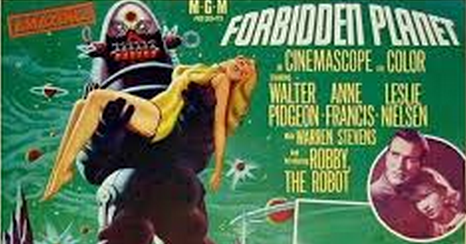
In changing some of the fundamental rules of the fictional world, filmmakers had to take some things for granted—you can’t be radical about everything at once—and one of the genre’s historical failings, discussed without much depth by the authors, was its presentation of women as sex objects. In SF musical caper Just Imagine, Mars looks much like a tropical hotel lobby full of scantily clad show girls who try to undress the heroes; far more pleasant than their Earth, where by their own admission they “hate these modern women.” In Forbidden Planet, the main female character Alta serves no purpose beyond providing a focus for sexual desire. At one point the Captain chides her outright for her short skirt, which is likely to provoke a sexual assault from one of his randy crew, if he doesn’t get there first (he does). Later, in Logan’s Run, the eponymous character is utterly baffled when, wearing a sleazy kimono, he materialises a woman in his flat, says “let’s have sex,” and is refused (don’t worry, she does end up having sex with him, and also getting spontaneously nude in an ice cave). After decades of SF films pandering to male fantasy, I was pleased to see the authors note the appearance of Princess Leia in 1977 with thoughts and actions all of her own, though they see her relative lack of sexualisation as being “repressed: a breach with tradition in the genre… Star Wars was scant female liberation.” I’d say it’s worth considering what came before.

The book fares much better with issues of race representation, pointing out the disconcertingly Aryan population of Logan’s Run, though omitting to mention how much the Carrousel ceremony looks like the Ku Klux Klan Winter Olympics. The authors even beat me at spot-the-minority in Just Imagine; their winning hand reveals a lone Japanese-looking man in a crowd scene. They also draw interesting parallels between the caste system of Planet of the Apes and the American Civil Rights Movement. In an early draft of the script, an underclass of baboons had been protesting with placards saying “Down With Discrimination.” Perhaps even more interesting is Charlton Heston’s chilling observation of the extras on location:

At lunch, the ape actors lunched separately, since their makeups limited them to liquid foods taken through a straw. But beyond that, they self-segregated by species: gorillas at one table, chimps at another, and orangutans at still a third.

It’s in these moments that the value and attraction of historical research outweighs theory.

The authors run through a kaleidoscope of influences on Star Wars, drawn from a huge array of different cultures. George Lucas lamented the lost mystique of the Orient, with its promises of an exotic other. He originally considered casting a Eurasian Princess Leia, an African American Han Solo, and even using an entirely Japanese cast. His debt to Japan was clear, and many other cultures went into constructing the world around them: a keen ethnographer might notice that the Jawas spoke Zulu and Swahili played in double-time. The human characters in the first film were all white, however, and “the only African-American in the piece was the voice of pure evil.” There was a so-called “black-lash” after its release, though the first person to point out the lack of ethnic mix only noticed after he’d paid to see the film four times.

Through dedicated research, Chapman and Gill chart many other themes: the relationship between the British and American film industries; the primacy of grand visuals over ideas in SF films; the rise of the SF blockbuster. In doing so, they have compiled a book that will satisfy the curiosity of the film student about the little islands of history that bore the final reels. More than that, it’s a surprisingly accessible gold mine of trivia and wry anecdotes, essential reading for the pub quiz master and a reliable reference for SF fans hoping to settle an argument.

The book gives you the plots and twists from the first page, but then almost every SF film I’ve watched has been spoiled in advance. If Planet of the Apes came up in conversation, we’d end up talking about the twist at the end: the buried Statue of Liberty. Until I was 24 I’d never watched the original Star Wars films, but of course I had heard several hundred bad Darth Vader impressions, always croaking, “Luke: I am your father,” like emphysema patients. No one ruined Robocop for me, but no one cares how Robocop ends.

So if this article has spoiled any of these films for you, I’m not sorry. For profit and for society, they aimed to start conversations. They are often more eloquent about the preoccupations of their times than any film directly accountable to the constraints of here and now. They don’t show us the future as a prediction, but as a warning: we are all making the world we will have to live in.

Sport vs spectacle

Pedestrians spill out of Wembley Park station. Lots of men are wearing hoodies and loose fitting jeans, with cropped hair and the occasional scar where hair won’t grow. Blue lights flash past as we converge on Wembley Arena. The UFC, or Ultimate Fighting Championship, has come to town.

The Ultimate Fighting Championship is the best known of the mixed martial arts (MMA) events, which were conceived to answer the old pub dilemma, “Who would have won in a fight between Bruce Lee and Mohammed Ali?” Every martial art claims to be the best fighting style on its own terms, but it had, until MMA, been a matter of dispute as to which might actually win in a no-holds-barred brawl. The answer seems to be a combination of boxing, wrestling, Muay Thai and Brazilian jiu-jitsu.

In the early days of UFC almost anything that might allow a fighter to emerge victorious was permitted. There was no limit to the number of rounds. John McCain, the failed presidential candidate, campaigned against the league in the 1990s, and succeeded in having the event banned in the majority of US states. Las Vegas casino owners the Fertitta brothers then bought the rights to the UFC—the contract included a clause which stipulated that any dispute between the two brothers would be settled in a jiu-jitsu match of three five-minute rounds—and they began the long process of rebranding UFC as a serious sport.

Rounds in the octagonal metal cage are five minutes long. There are eight weight classes. But even in an increasingly regulated spectator sport, only the most extreme strategies are disallowed. The rule book’s brief list of fouls includes “putting a finger into any orifice,” “spiking an opponent to the canvas on his head or neck,” and “attacking an opponent who is under the care of the referee.” It explicitly states that you are not allowed to throw in the towel without the referee’s consent.

Notice, too, that the rules say “his.” There are women fighters, but this is a hyper-male sport. Poor Ernest Hemingway might not have known what to make of our modern world, where fishing must be humane and sustainable, bullfighting may be banned and the US president himself is pushing for gun control—but he would have felt at home with mixed martial arts, which harks back to an ancient masculinity.

My brothers and I find our seats and watch English fighter Tom “Kong” Watson knock Stanislav Nedkov to the floor with his elbows, knees and fists. A spot of blood hits the lens on one of the four close-up cameras trained on Nedkov’s fallen body as a referee throws himself between the victor and his opponent. The crowd cheers heartily.

The heaving arena is lit by the glow of roving spotlights and wrestling-style branding, flashing up the UFC logo on the six giant screens at either end. My two brothers are on my right; to my left are two men in their late thirties, also brothers, and their father, who looks a bit like Steven Berkoff. Behind us, in the rafters, is a group of loud Scousers, who remain standing throughout. Everyone has plastic cups of Becks Vier. Glass would be a bad idea. There are seven preliminary fights tonight, and another five on the main card. Ten thousand people have paid a total of almost £900,000 to be here.

As the song “Move” by Thousand Foot Crutch ends, the next fighters are announced. They have their eyebrows smothered in Vaseline and are let into the octagon. My older brother explains the term “ground and pound” while we watch. It means sitting on or standing over your opponent and hitting him in the face until someone stops you. After the first round, the ring girl, Brittney Palmer, to whom a whole double-page spread in the programme has been dedicated, sashays around the eight sides of the cage. There are wolf whistles and some horrible things are said. One of the four cameramen tracks her as she sits back down. She notices him, smiles, gives a little wave with her fingers and mimes a kiss to the viewer.

I turn to one of the men to my left, just as he says, “I want to see a leg get broken.” I ask him why everyone is crowding round a particular spot on the ground near ringside. “People want a photograph with the Freakshow,” he explains. Down there, among the crowd, is Colin “Freakshow” Fletcher, a British fan favourite, who is not fighting tonight. He is known for taking as many punches as necessary in order to get close enough to strangle his opponent. Seven of his eight wins have been by submission. He is also known for wearing clown makeup, and being accompanied in his entrance by men in gimp masks and on leashes. There are people who think MMA is an ignoble sport. But one might argue that it is not a sport; it is a spectacle.

Terry Etim is coming up next. Along with Fletcher, he is among a new generation of British MMA fighters who have followed in the wake of Michael Bisping, the first Brit to headline a UFC card, way back in UFC 78 (we’re now at 157). Etim is from Liverpool, and the Scousers behind us go wild as he is announced. He has a six-inch height advantage on Renée Forte, and glares straight ahead as he enters to “In the Air Tonight” by Phil Collins. The whole crowd is behind him. Forte comes out, short, less angry looking, and they fight tentatively. Forte works Etim’s left knee; Etim has a quick, high push kick that he keeps trying to land. Etim loses on points, by unanimous decision, and the crowd is despondent. There was no grand victory; there were not even good strikes for the slow-motion replays. In three days’ time, Etim will be released by the UFC. Two of the other UK fighters, Paul Sass and Che Mills, will also be dropped. It is Mills’s first loss, but UFC president Dana White is disappointed by his failure to “drop punches, elbows—go absolutely apeshit” in the last round. The crowd must have their broken legs.

We go out to get more beer. There is a long queue for the men’s toilet and no queue for the women’s.

The next winner, James Te Huna, gives a shout out to his young nephew. I hope the nephew was only allowed to watch his Men in Black pastiche entrance, and not the fight itself, when Te Huna took a roundhouse kick to the neck and was repeatedly elbowed into the canvas, requiring two men with towels to clean up the blood.

After three hours, I have begun to think about each fight much more in terms of strategy, though it’s hard to completely set aside the human cost. The fighting is highly technical—more so than boxing, because of the versatility of the fighters—and like chess games, fights tend to move along established pathways of aggression and counter. Jimi Manuwa attacks four-time Muay Thai world champion Cyrille Diabaté. I watch Manuwa try to take Diabaté down to the ground and away from his comfort zone, Diabaté keeping him at bay with quick knees to the body in clinch. At the end of the first round, the referee calls the doctor over to Diabaté’s corner. His leg won’t support him. The fight is called off and the crowd have their broken leg. They boo. Diabaté is helped off and they clap him out. It is not the fighter they object to, since he isn’t allowed to throw in the towel himself; it is the meddling bureaucrat who has called off the fight because of a mere torn calf.

Cub Swanson and Dustin Poirier are up next for the penultimate fight. They look like Orlando Bloom and Elijah Wood respectively, if each actor had shaved his head, covered his upper body in tattoos and started a prison gang. Swanson has a neat line shaved, or scarred, into his right eyebrow. Poirier has one cauliflower ear.

My little brother leans in to talk in my ear. “He looks like a total psycho.”

I don’t know which of the two he means.

Poirier starts scrappy, and Swanson quickly goes for a roundhouse and misses with an uppercut. Swanson seems the more brutal, I think, as he tries to land a flying knee. He was the one screaming, open mouthed, when his name was announced. Swanson kicks again but Poirier has seen it coming and tips up his foot, temporarily downing Swanson, who wrenches his leg free before it can be used in a big takedown. In the second round they box pretty solidly, though Swanson is still trying for more audacious, heavy hits. Swanson is certainly more in control in the second half: he executes a textbook takedown and then, having pinned Poirier to the floor, he grins up at the nearest camera and lifts a hand to his ear to urge on the crowd’s roars. Swanson understands that fighting is only half of his job. He wins by unanimous decision.

The music starts up again: “watching the people get lairy…” After this brief incitement to riot, we are played a teaser video for the title fight. It is the Interim Bantamweight Championship, with favourite Renan Barao fighting Michael McDonald. Both are shown knocking people unconscious in inventive ways, or battering the head of an already unconscious opponent.

McDonald enters to a dulcet song. It’s like a nursery rhyme in a horror film. Barao enters with a brightly glowing gum shield. The stats on the big screen say that Barao has a winning streak of 30 fights. From the start of round one, time seems to speed up. Barao attempts an early spinning back kick but he is out of reach. McDonald surges at him with a flurry of punches. He lands two left hooks and takes Barao to ground. Soon they are up again. It feels as if any second could be the last of the fight.

In the second round, they wear each other down, testing boundaries. Barao bunches his shoulders; McDonald stays lively, bouncing on the balls of his feet. Both are bleeding on their face; McDonald also on his left shoulder. In the third round, out of nowhere, Barao lands a spinning back kick straight in the chest. McDonald stumbles back but, incredibly, keeps fighting.

“At least it wasn’t in the face,” says my younger brother.

We watch the slow-motion replay, and it was in the face. The kick caught McDonald on the chin, a blow that should have knocked his jaw off, but he stayed on his feet, and he’s still in for round four. Barao takes him down and he manages to get back up again, but Barao brings him back down to ground, one knee on his stomach, his right arm and throat caught in a tight arm-triangle choke hold. Seconds pass. The referee asks for a sign that he’s conscious and McDonald gives the thumbs up. He’s weakening, gradually. More seconds pass. He taps out.

The crowd suddenly erupts as Barao jumps up and begins to dance. The interviewer tries not to laugh as he asks questions to an interpreter, who translates the question into Portuguese, receives Barao’s answer and translates it back to English. Blood and choking is a good end to the night.

After just six hours and 12 fights, my brothers and I are back out on the streets of Wembley. Tom Watson receives two £33,000 bonuses for best knockout and best fight, worth multiples of his normal pay. It is a codified sport, but you can only hit the real money if you entertain, and you might lose your place in the roster if you don’t. As Barao said in the pre-fight interview: “I will put on a good show once again.”

Black Vodka by Deborah Levy

In Deborah Levy’s latest collection, Black Vodka, are ten stories which open up her world. They are stories about trying to find out who we are in the course of our everyday lives, and about how we can remain deeply imprinted by those who are close to us. Here, as in her previous plays, stories and novels, her writing exhibits a rhetorical severity which, at its best, has a mythic, lullaby quality, experimental and at the same time simple and beautiful.

It is difficult to say what the collection is about, for two reasons. Firstly, to tell you the conceit of each story would, more often than not, misrepresent the experience of reading them (on which, more later). Secondly, as with many of the best writers, one can’t help but feel that, somewhere, Levy must be holding onto an ur-story from which all her others digress or refract. For Haruki Murakami, the received wisdom has it, this story would almost definitely involve cats, a haunting song, a bizarre sexual encounter, a dream sequence. So too in Black Vodka we glimpse, from time to time, the story that Deborah Levy is compelled to tell and re-tell. A rich creative figure, not quite clear of the (social or military) conflict in his past; a geographical foreigner who has become foreign to themselves; a young lady in a light dress who loves swans or their feathers; inward conflict blossoming into eczema; water and the danger, or perhaps the thrill, of investigating below its surface. If you have read Swimming Home, this may all have a ring of familiarity.

I have had trouble convincing people to read Swimming Home, even since its Booker nomination this year, because – and I feel this is a problem specific to Levy – the plot itself, which people tend to use as an indicator of what a book is ‘about’, is no more than an arbitrary vessel for her ideas. A middle class family goes on holiday to France, and a kooky ginger girl turns up to make trouble. It is almost as if someone has picked the idea out of a list of rejected film plots and challenged Levy to turn it into something interesting. It is a tightrope walk, a daredevil stunt. Part of the pleasure of watching her do it is that you don’t believe she or anyone can pull it off. But the writing is incisive and mercurial, the characters somehow depart from their archetypes to become unique, their experience of the world vivid and layered. As the main character from Black Vodka‘s title story puts it, ‘Better slowly to prove more interesting than I first appear.’

And so it proves. In Levy’s hands, the world of advertising, normally so glib and reductive and lacking in its capacity to really attach itself to human experience, transforms into a research centre for the exploration of the unconscious. Someone laughs uneasily when our hero insists that Vodka Noir has high cheekbones, but why not? He wakes from dreams of Warsaw with tears on his cheeks, ‘transparent as vodka but warm as rain.’ Rain is traditionally cold, but Levy has a Symbolist poet’s eye for telling substitutions. In a description from the story ‘Vienna’, a man muses on his lover:

She is middle Europe, he thinks. She is Vienna. She is Austria. She is a silver teaspoon. She is cream. She is schnapps. She is strudel dusted with white icing sugar. She is the sound of polite applause.

The description goes on, and we are carried with it. It is exhaustive and we never feel she is running out of steam. In these moments it is impossible not to believe in the sheer power of Levy’s imagination and the easy way she renders it in prose. Who cares what she is writing about? She is doing it so well.

41POldApLAL._SL500_

The only time that the collection falters is when the narrative voice strays too far from Levy’s own. ‘Cave Girl’ is the runt of the litter, and will very likely get beaten up by the other stories when you close the cover. In this story, a boy rhapsodises about his sister, who has had a dramatic makeover. There is still a lot of observant detail which carries the narrative forward, but I just don’t believe the voice. Levy can only do one voice – it is her own, and it is exquisite. But I don’t believe in a young boy who would talk in well turned out prose about Ancients, and condensing ‘them’ to ‘em’ or spelling stupid with two Os won’t change my mind. I’m not sure I would even wish to meet a boy who comes out with asides like, ‘Mr Lewinstein, who is quite good-looking I suppose (everyone knows he’s got a mistress in Malta).’ It would be like having to talk to a society girl without the anaesthetic of champagne.

‘Stardust Nation’, on the other hand, is Levy at her best. A strange, dreamlike atmosphere pervades this story about a man and his overly empathetic employee, who becomes confused and begins to tell the story of the protagonist’s life back to him. New information strings the reader along while incantations are introduced, repeated, mutated. What starts as a baffling unreality begins to seem dizzyingly inevitable. Levy writes the story of a man’s breakdown as a kind of thriller, borrowing technically from the genre without bowing to its overworked content. It is like reading an update of Edgar Allen Poe’s ‘William Wilson’. The story challenges the myth that only literary realism can speak deeply of people’s inner lives, perhaps even challenges the myth of the inner life as something we create without the collaboration of others.

You should read these stories – nine out of ten, anyway – for their ideas, and the sheer quotability of her writing. Levy puts poetry in her prose, and has the rare ability to make us see our familiar world afresh, ‘like new paint and old pain.’ I will be pressing my copy into the hands of my friends, and I will enjoy talking over the questions they raise about how we construct our selves and whether we can ever outmanoeuvre our past.