Agent Hunter Q&A

This is a Q&A I did with Agent Hunter, run by the Writers’ Workshop to help aspiring writers find the right agent and get tips on the publishing process.


Q. What books/authors do you love in commercial fiction? (Crime, women’s) Give us some examples and say why you liked these books/authors.

I love Patricia Highsmith’s Ripley series – they’re so quick and cunning, and she evokes her landscape with spare but telling detail, whether they’re in the French countryside or on the Italian coast. She also carries the plot with a tight cast of just three or four main characters and a couple to support. It’s masterful. I also love Thomas Harris’s Hannibal series (the original three, not that godawful Hannibal Rising). Harris pulls you along with great twists and a worthy adversary, but you learn about memory palaces and harpsichords along the way, which is somehow just really cool. It sounds as if I only read books about psychopaths, but I’d rather say I’m compelled by characters who operate with impunity.


Q. What books/authors do you love in literary/historical/book group fiction? Examples and reasons, please!

This is tough. I got into publishing because I love literature and so it would be a tempting cop-out to say ‘books that are just really good.’ Why do I read a book when I could be seeing my friends or watching TV? I think really good books speak to us about what it means to be human beyond the everyday – to live, to grow up, to love, to fail, to die. Novels can be about anything on the surface but I think ultimately they need to address those universal concerns, which the best writers do: George Saunders, George Orwell, Cormac McCarthy, Jennifer Egan, Julian Barnes, David Foster Wallace. I don’t think writing needs to be ‘difficult’ to be good. J K Rowling, David Nicholls and Mark Haddon write very different books but they make you invest deeply in their characters, and you have to keep turning pages to find out if they’re going to be okay.


Q. How about sci-fi/horror/fantasy/paranormal/YA dystopian/erotic? What would you be interested in, and what’s a big no?

I guess this isn’t my natural core of interests, but I do like high concepts and speculative fiction. I’d have loved to see a book like The Age of Miracles by Karen Thompson Walker, about the day the Earth’s rotation mysteriously slowed down (though I thought the idea was better than the execution). Or Under the Skin by Michel Faber, which gets weirder and weirder but in a way that somehow feels very organic – an extension of the world that I know.


Q. On the non-fiction side, are there particular areas that interest you? Does your non-fiction list have a particular slant to it?

I think good non-fiction should strive to improve our understanding of the world around us. It’s a wide brief, and I am as interested in biography (Limonov by Emmanuel Carrère) as in books about economics (Ha Joon Chang) or science (Philip Ball, Jared Diamond, Jim al-Khalili). I particularly love reading accessible books by academics about their field, or by journalists who are investigating an untold story. My current list encompasses hard science, social history, true crime, current affairs and memoir.


Q. And are there any areas of zero interest to you in non-fiction? What would you NOT want to see?

I would say I’m not the right person for royal or military history – those books are published so often and so well that it would be hard to make a lasting contribution.


Q. What (very roughly) is the balance of your list between literary fiction / commercial fiction / non-fiction?

At the moment I have more non-fiction than fiction, but I am building my list, and the difference is that with fiction I am looking for authors who I can back for their whole writing careers, whereas with non-fiction it may be that someone only has one book they want to write – a true story they’ve found or an account of a long research project. Finding novelists is harder, but when you love their writing it will hopefully last a long time – I’m proud to be working on the third novel by my first client, Lisa O’Donnell, at the moment.


Q. What are your biggest peeves in an opening page or opening chapter? And what do you love to see?

I want something to happen. Too often writers see the opening as a period of grace where they need to get all the boring backstory and set up out the way. Kurt Vonnegut said you should ‘start as close to the end as possible.’ If you know about the main character’s family going back four generations, I’m pleased for you – you’ve done your research. But are you telling me because it’s really part of the story, or to prove something else? Imagine someone has picked up your book in a shop (a shop full of books) and has allocated about five seconds to glance at the first page to see if it looks interesting.


Q. Would you take on an author who had self-published? What kind of self-pub sales would make you sit up?

I did this year. I represent Nick Louth, a thriller writer who self-published on the Kindle Direct Platform. He had sold around 50,000 copies in one month (he’s now sold five times that number), and we decided to work together on a traditional UK publication. His book will come out in 2015 with Sphere (part of Little, Brown), and will be published separately in Dutch, French, German, Italian, Portuguese and, oddly, Serbian.


Q. What single piece of advice would you most want to give writers?

Editing is not a compromise. Editing is saving you embarrassment when the critics get hold of it. Editing is your kind old teacher quietly mentioning that your flies are undone before any of your classmates has noticed.


Q: Which 3 famous people (alive or deceased) would you invite to a dinner party and why?

I should say straight off the bat that these are not necessarily my favourite writers. But which writers would really ‘bring the party’? Milton, for instance, is one of the greatest writers in the English language but also a bit of a killjoy.

I would invite Hemingway, for his anecdotes and his general drinking stamina; Tolstoy, for his sheer barefooted craziness; Angela Carter, who I think would somehow keep the night on track while giving as good as she got. Plus, I would pay a lot of money to see her and Hemingway arguing. The conversation would teeter on the absolute brink of madness and genius.
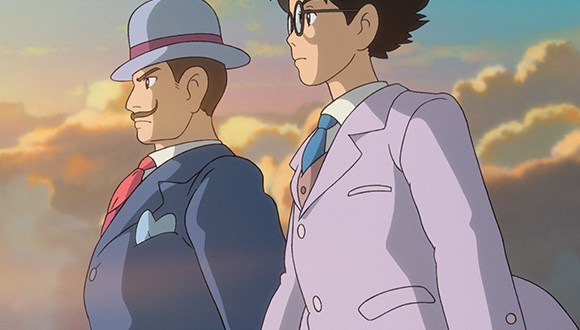
Miyazaki’s final vision

The animator-auteur Hayao Miyazaki has announced his retirement many times before, most famously after the success of Princess Mononoke (1997). Unlike most retired people, he has continued to make films, winning an Oscar for Spirited Away (2001) and receiving a nomination for Howl’s Moving Castle (2004). He has claimed that his latest, The Wind Rises (out in the UK on 9th May), really will be his last. “This time I am quite serious,” Miyazaki told theAssociated Press last year. By some counts, this is his seventh retirement.

Since that interview, his friend and co-founder of Studio Ghibli, Isao Takahata, has hinted that Miyazaki may find another project. He will be forgiven if he does decide to break his promise again—Miyazaki is no self-promoting cynic. His films are about people who are trying to do the right thing: to prevent disaster or to save a loved one. His female characters, young and old, are more human than almost anything Hollywood serves up. Even his villains are not as bad as they seem—they often end up getting on pretty well with the other characters.

This sounds worthy, and a recipe for commercial disaster. Yet Miyazaki’s animations are not only hugely popular, they are regarded as some of the greatest films ever made. Part of the appeal is the observational detail that he brings to every scene. The critic Roger Ebert once noted the “gratuitous motion” in his films, which Miyazaki likens to the Japanese concept of ma or emptiness—those little reflective pauses in which we notice an animal shaking itself free of water, or a colleague straightening his waistcoat. These moments create a kind of visual poetry, a celebration of the beauty in the everyday, like the graphic novellas of John McNaught. Miyazaki is a master of these moments. His films would rather make each moment beautiful than cut to the chase, and Miyazaki has no one to curtail his vision: he writes the scripts, designs the storyboards and draws thousands of key frames himself.

The Wind Rises is ostensibly the biography of Jiro Horikoshi, a pioneering aeronautical engineer who was responsible for designing the Mitsubishi A6M Zero Fighter used by the Japanese Navy throughout the Second World War. Although a real historical figure, Miyazaki presents Jiro as a Harry Potterish everyman and tweaks his life story to accommodate his own preoccupations.

When Miyazaki was a child in the 1940s, his father and uncle owned an aviation company that made parts for the Zeros, ensuring that no one in the family was conscripted to fight. Planes appear everywhere in Miyazaki’s work: the ominous shadows passing over the city in Howl’s Moving Castle before an air raid; the possessed paper planes inSpirited Away; the young neighbour’s toy plane in My Neighbour Totoro. And then there’s Porco Rosso, which is about a pig who is a bounty hunter and pilot. There are almost as many planes in that film as there are people.

The Wind Rises begins with a plane. We first meet Jiro as a sleeping child. In his dream, he climbs up onto the roof of his house and gets into a plane with feather-tipped wings, rising up vertically with perfect dream logic. But up there, in the sky, are monsters, loitering on bombs like the shadowy pilots in Howl’s Moving Castle. Jiro falls and lands… in reality.

He has woken up. The mosquito netting around him is blurred. He puts on his glasses and the room comes into focus. Here we are introduced to one of the most surprising elements of Miyazaki’s final film: it is set in the real world. His final challenge to himself has been to create a film without strange creatures or transformative curses. This world is governed by normal physics, so much so that the (animated, fictitious) camera has a depth of field and is susceptible to lens flare. Many of Jiro’s conversations concern the precise aerodynamics of the plane he’s designing. We see drawing board diagrams and designs in other Miyazaki films such as Porco Rosso and Totoro, yet in The Wind Risesthere is a new attention to physical reality. We watch over Jiro’s shoulder, like a supervisor, as he notes down the calculations on his slide-rule.

Jiro is an underdog, determined to make a plane to rival the industrial powerhouses to the West, despite Japan’s poor resources. Through his nightly dreams, and days of hard work at his desk, he renders a whole new reality. It couldn’t be a more literal analogy for Miyazaki’s work. Later, the engineer marries a painter—another fitting metaphor. The film is full of painterly skies and sunlit fields, sea and mountains. We see a cherry tree blossoming, moths gathering around lamps, the smoke from a cigarette or a cold breath curling into the air. We watch dappled light move over Jiro’s body on a woodland walk, and even see the shadows of objects offscreen, the silhouette of an unseen tree running across the floor and up the side of a building.

There are no serious antagonists in The Wind Rises. The most important relationship in the film is the love affair between Jiro and Naoko. When she was a child, Jiro saved her and her nanny from the chaos of an earthquake, carrying them from a railroad as burning detritus blew overhead from the city. Now she is a beautiful woman, Claude Monet’s Woman with a Parasol come to life, and she has found him—but, like the mother in My Neighbour Totoro, she has tuberculosis. Jiro and Naoko love each other devotedly, and decide to marry despite her being almost bed-bound, and his being wanted by the interior ministry. It would be hard not to smile at their courtship, watching them throw paper planes onto each other’s balcony, or make youthful declarations to one another.

The central conflict in the film comes from the plane itself. It is the perfect meeting point of the opposing forces that shape Miyazaki’s attitude towards technology: freedom and destruction, one sometimes necessitating the other. In Princess Mononoke, which echoes the earlier film Nausicaä of the Valley of the Wind, Ashitaka fights against a human society obsessed with building ever more efficient guns. Miyazaki is always careful to show how technology consumes. The candle that powers the steam boat in Ponyo runs outand there is a constant stream of coal in Kamaji’s boiler room in Spirited Away. Technology can also, sometimes, provide us with a seemingly limitless freedom, captured so well by his vehicles: the magic Cheshire Cat bus in My Neighbour Totoro, which bounds across landscapes in an instant, or the famous moving castle whose doors open onto different cities. In The Wind Rises, the plane embodies all of these qualities at once, belching exhaust fumes, describing perfect ellipses in the sky. It can kill even as it fulfils one of humanity’s great dreams, to fly among the clouds.

Some critics, both in Japan and in America, have criticised the film for supposedly glorifying Horikoshi’s contribution to the war. In fact, Jiro suggests during a design briefing that they remove the guns and, at one point, even finds himself strolling through the wreckages of crashed Zero fighters. If the film had come on any stronger with its anti-war message, it would have been patronising. Perhaps the criticism stems from the claim by Jiro’s role model, Caproni, that “aeroplanes are beautiful dreams.” The criticism is presumably that we mustn’t gloss over the brutal devastation of war; that every film set during a war should strive to imitate Schindler’s List. But in Miyazaki’s work, no one sets out to do evil, even if the result creates conflict. In Princess Mononoke, the humans are not making guns because they are malicious, but to protect the vulnerable and their livelihood. Every character is simply trying to further their own cause, or to perfect what they already do well. If only Jiro would play the villain, we could all condemn him, refuse to understand why he lived the way he did, and learn nothing.

Jiro is certainly not perfect, and his dogged quest to produce something beautiful puts a strain on his relationships with those around him. Caproni understands this impulse perfectly. He has been a kind of spirit guide through the film for Jiro, and ends by reassuring him that his work is over, and that “artists are only creative for ten years.” All that remains is to be grateful for the time that he had.

Miyazaki has been making films for far longer, of course, and his most recent have been among his best. It seems hard to believe that he will retire now. He is getting older, of course, and his artistic process is immensely demanding. But the real clue as to why Miyazaki has declared The Wind Rises his last film may lie in his childhood.

In 1945, when Miyazaki was four, the city where he lived with his father the aeroplane engineer, was bombed. The family was evacuated to a railway bridge. The sky was pink with flame. They got hold of a truck and, as they escaped the city, a woman and a child asked for a lift. But Miyazaki’s family drove on without stopping. It was an apparent failure of kindness, and he wondered later if it could have happened differently. Soon after the war ended, his mother contracted spinal tuberculosis, and underwent treatment for the next eight years.

Watching The Wind Rises, it feels as though this is the story Miyazaki has been coming round to all these years—the final, realist vision to resolve all those recurring images of planes, burning skies, the woman and child in need, the debilitating tuberculosis of a loved one. Over three decades, this raw material has provided fuel for his gorgeous fantasy. Now, at last, it has been transformed back into reality.

The Winding Refn Commandments

Drive is one of my favourite films, so when I saw the poster for Only God Forgives – also directed by Nicolas Winding Refn, and starring Ryan Gosling – I bought a ticket. I’m the sort of person that watches a film once and, having ‘completed’ watching it, never return, but I’ve seen Drive four times now, and own the DVD. Everything about it works perfectly, from its gorgeous pink lettering to the scorpion jacket and custom Patek Philippe watch, from the glimpses of ultraviolence to the kitsch soundtrack by Cliff Martinez. The film also escapes that feeling of death by Hollywood committee, whilst maintaining popular appeal.

Only God Forgives seemed to promise another defined aesthetic, swapping boygirl-next-door Cary Mulligan for a badass Kristin Scott Thomas and involving muay thai. (If you don’t already love muay thai, watch Chocolate.) But this follow up has none of the purpose of Drive, and none of the nuance in its performances. The whole film can be summed up in a few simple rules.

  1. No one can be in the vicinity of the Gosling without feeling a strong sexual tension. Not even his mother. In fact, why not go all the way with the Oedipus thing.
  2. Walk in straight lines as if you are ripping off Wes Anderson. If you don’t walk slow enough, you will be slo-moed. Keep your arms by your side. This film is not about momentum.
  3. Do not make any facial expressions. Neutral faces are tense and ambiguous.
  4. Foley doesn’t need to sound like real things. It just needs to be punchy. Especially punches.
  5. All scenes that can turn violent will. The only thing better than violence is Tarantino-esque farcical violence.
  6. Women are nice to look at, therefore lingering shots of women are self-justifying.
  7. People do karaoke in Asia. We mustn’t be allowed to forget that.
  8. The colour of sex and violence is red. The colour of atmosphere is black. Yellow is for interludes, blue for slightly depressing moments. (Note on cynicism: Winding Refn is colour blind, but I, the viewer, am not, and presumably neither was his DOP.)
  9. Our hero tries to do good things, but does some really bad things for reasons that are never explained. This makes him a Complex Character.
  10. Film is a visual language, so characters should say almost nothing. If they must speak, turn off the audio so that they are essentially mouthing.

Worse than the experience of watching Only God Forgives, is how painfully this new film bares its method to the viewer. I even began to worry that, having seen how gimcrack Winding Refn’s toolbox was, I might have ruined the magic of Drive. But Drive stands up to criticisms like those above. Drive is pensive, rather than slow; stylish rather than pretentious; Drive had a professional screenwriter, where Only God Forgives had Nicolas Winding Refn. Most importantly, Drive had characters who cared deeply about one another – the dilemma at the heart of Gosling’s Driver was how to be, as the soundtrack put it, ‘a real human being, and a real hero.’ Even the villains reasoned out their decisions, whereas in this new film, there are no heroes, and too frequently there are no reasons.

So despite Only God Forgives (and despite his previous effort, Valhalla Rising), I still like Winding Refn. But rather than think of him as a visionary, I have come to think of him as a brave experimentalist who got lucky, once, with a film that happened to hide his blind spots and present his foibles as strengths. If he makes another film, I might see it. Even lightning sometimes strikes twice.