The Pixar Guide to Wellbeing

On its release in America, Inside Out had the biggest opening weekend for any original film in box office history, sailing easily past Avatar’s $77m to an incredible $91m. It’s already Pixar’s eighth consecutive film to have taken over $500m worldwide, and we’ve only just had the opening weekend here in the UK, where it took £7.35m. If some were beginning to worry that the studio had gone the way of Disney, following five years of prequels, sequels and the critically mixed reception to their fairy tale, Brave, this new film has proven that Pixar is still capable of the funny, surprising and layered storytelling that made its name. But the secret ingredient of this film’s success? Sadness.

Inside Out follows 11-year-old Riley and the five emotions – joy, fear, anger, disgust and sadness – that live in the control room of her head. When Riley’s family moves away from her childhood home in Minnesota to San Francisco, she loses sight of the core memories that tell her who she is, prompting Joy and Sadness to go on a journey deep into her mind to get them back. The topography grates: having to catch the Train of Thought home because Honesty Island has crumbled sounds like the worst allegory since Pilgrim’s Progress, if you think about it too hard. But as Ed Catmull, Pixar’s co-founder and president, wrote in his book Creativity Inc., ‘If you give a good idea to a mediocre team, they will screw it up. If you give a mediocre idea to a brilliant team, they will either fix it or throw it away and come up with something better,’ and in the hands of Pixar’s story artists, the landscape of Riley’s mind becomes the battleground for a new way of looking at wellbeing.

It’s one of Pixar’s funniest films, the jokes coming thick and fast throughout the film (‘There’s inductive reasoning, there’s déjà vu, there’s language processing, there’s déjà vu, there’s critical thinking, there’s déjà vu…’). Perhaps the best gag is watching the maintenance workers hoover up long term memories like phone numbers (‘We don’t need these! They’re in her phone’), leaving only the names of a couple of US presidents and the ditty to a chewing gum advert.

Riley’s main problems – growing up, and moving away from her childhood home – are identical to those of Pixar’s first feature film, Toy Story. In the latter, Andy’s fear and distress is played out by the toys, the whole story enacting the kind of imaginary play we might expect to see in a child’s psychological evaluation, with Woody and Buzz vying as male role models (the implication being that the family is downsizing following a divorce). When Inside Out treats the same topic, the adventure is the emotional journey itself: will Joy reign over Riley’s head once again?

Up to now, Joy has called the shots in Riley’s mental HQ, and she keeps life on track by being relentlessly positive, looking for the bright side in everything and telling the others to ‘think positive’. When Sadness starts to intrude on the controls, Joy’s response is to draw a chalk circle on the ground and tell her to stand inside it. But when things go really wrong for Riley, it’s not because Sadness has taken the helm and won’t let go. Instead, the colour drains out of the console, and it stops responding to any of the emotions. As sufferers of depression attest, the problem is not overwhelming feeling but the inability to feel.

Inside Out SadnessThis is where Sadness comes in. When we get a glimpse into Riley’s mother’s head at the dinner table, we can see her own Sadness is in charge of operations, and that’s why, even though yellow Joy is generally in charge of Riley’s HQ, she has Sadness’s blue hair and aura. Perhaps worried that Riley might take after her, Riley’s mother wants her to be a ‘happy girl’, but as things go from bad to worse, the pressure to be happy begins to seem like the real problem. Indeed, recent studies by social psychologist Dr Brock Bastian and others confirm that negativity is often our most useful companion when times are tough – it helps us anticipate problems, find solutions and empathise with others when things are going badly. It’s not negative emotions that are bad for us, but the suppression of them, especially when they are healthy, functional responses to difficult situations.

Pixar have never shied away from presenting everything that life can throw at you. Perhaps the most famous example is in the montage of Carl and Ellie’s life together at the start of Up, which, taken alone, stands as perhaps the greatest short film of all time, not just for its miracle of condensation, but for the emotional impact of their childlessness, which has reduced audiences of all ages to tears. (Careful viewers may even spot scenes from this sequence in the great bowling-ball alleys of Riley’s long term memory.) Equally, on the death of Riley’s imaginary friend, who sacrifices himself to save Joy, the cinema erupted with the sound of children crying, which is just as well because I think a number of the adults were sniffing too. The whole audience left the cinema elated.

In this latest film, Pixar are not just putting us through the mill. They’re showing us that, somewhat paradoxically, the way to be really happy is to experience a whole range of emotions. When Riley is born, there is only Joy, standing in front of a laughter button, but as Riley grows older, she is joined by Anger, Disgust, Fear and Sadness. When life gets really tough, Sadness is not the antagonist she first appears, but the unsung hero. That’s the real lesson: Joy might be fun to hang around, but wellbeing is a team effort.

Article first published by Prospect Magazine

The End of Serial

The final episode of Serial is out, marking the end of a series that has single-handedly revived the podcast as a cutting-edge medium, with over 20m downloads. For the past two months, the world has been gripped by the case of Adnan Syed, who was convicted in 1999 for the murder of his high-school sweetheart, Hae Min Lee, in Baltimore County. The show has been produced by This American Life, a weekly staple at NPR which has told a self-contained story in an hour, presented for the past twenty years by Ira Glass, who has also been involved in Serial. BBC Radio 4 Extra has just picked it up for broadcast in the UK. However, it has gained its huge following primarily through word of mouth.

Over the past two months, I have heard countless versions of the following conversation:

“Have you been listening to Serial?”

The listener tends to look baffled at this point, as if they have been asked whether they eavesdrop on their breakfast.

“Serial with an S.”

Oh, like serial killer.”

The way that the show’s producer and narrator Sarah Koenig tells it, the idea was to tell one story over a number of episodes, unpacking it gradually and building up a detailed picture of each aspect of the story. “We’ll follow the plot and characters wherever they take us and we won’t know what happens at the end of the story until we get there, not long before you get there with us,” she said on the Serial website. But it’s certainly not the only meaning that the word ‘serial’ evokes, and although the producers were keen to emphasise responsible reporting, true crime has an uneasy relationship with its subjects, profiting from and publicising a crime while simultaneously claiming to stand apart from it as a neutral investigator of truth. As the podcast gained in popularity, online speculation proliferated on sites like Slate and Reddit, of the kind one might expect of a fictional series like True Detective, with some listeners trying to contact the people involved against their wishes.

Koenig has found herself reporting details of the private lives of those relevant to the case (“I’ve had to ask about teenagers’ sex lives – where, how often, with whom?—about notes they passed in class, their drug habits, their relationships with their parents”), and although she has occasionally expressed discomfort with this role, there is a real public interest, because each episode has explored the very real possibility that Adnan is innocent. It turns out that several pieces of the prosecution’s evidence are incoherent and Adnan’s lawyer didn’t use his best alibi (which is significant enough that the Maryland court of special appeals has now shown an interest).

In later episodes, Koenig has been receiving new information from people following the podcasts – people who say they knew what Adnan’s alleged accomplice, Jay, was really like, or that there wasn’t a phone booth where the prosecution claims Adnan made a call. It turns out that there was, in fact, a phone booth there, which raises questions about who might have been calling in, and what their own motivations are. Perhaps the podcast is the best way to call for further witnesses; perhaps it is an open invitation for third parties to manipulate the case by offering false evidence.

Koenig herself has been remarkably restrained. As she points out in the first episode, “I’m not a detective or a private investigator. I’m not even a crime reporter.” She doesn’t presume innocence, as one does in a court case, nor, crucially, does she presume guilt as we do in cop shows, because of the inevitability of their resolution. She found out about the case a year ago from Rabia Chaudry, a lawyer who knows Adnan, and, agreeing with her that the prosecutor’s case had some important inconsistencies, has investigated every piece of evidence with an attitude of cool agnosticism. Koenig has obsessed over its minutiae, spending longer than many lawyers or prosecutors could afford to spend on a seemingly shut case in the quest for a piece of evidence that would reveal what really happened on the day of the murder. But she has also kept a relentless focus on the problems with trusting witness accounts, the difficulty of remembering and accounting for one’s time, the fallibility of any apparent proof, reinventing rules of true crime that have remained largely unchallenged since Truman Capote.

Adnan has now requested a DNA test, which for some reason was never taken by prosecutors at the time of trial, and agreed to participate in Koenig’s series, which does seem to suggest that there’s a chance he may be acquitted. Perhaps having one’s life framed as entertainment, sponsored by MailChimp, Audible, Squarespace and Trunk Club, is the price that the innocent have to pay to interest the world in an old case.

It will be interesting to see what Koenig and her team pick for their second Serial. It could be another murder case, but it doesn’t have to be: it could be a missing person; a lost artefact; a purported art forgery. Her listeners have been fascinated by the case, but not because its details were especially grisly or salacious – rather, it is a testament to her storytelling ability, to have introduced complexity into the story so gradually, guiding the reader through the evidence with so many twists which overturn our assumptions and keep us guessing. (Or, as Adnan puts it to Koenig in a rare loss of composure, after she asks him about stealing money from his mosque as a teenager, “You go from my saviour to my executioner just, like… flip flop, flip flop, like Mitt Romney.”)

The next series will engage a ready-made audience of millions, and whether she likes it or not, that will have a bearing on the lives of her subjects. They are real lives, and that is why we have been gripped, why the stakes are higher, why it’s so important to be responsible. “We don’t know yet what the story will be,” she said in her call for donations, “but whatever it is, we’ll make it good.”

p.s. Any lovers of the Serial theme by Nick Thorburn should check out fafu’s mashup with Notorious BIG on Soundcloud.

Miyazaki’s final vision

The animator-auteur Hayao Miyazaki has announced his retirement many times before, most famously after the success of Princess Mononoke (1997). Unlike most retired people, he has continued to make films, winning an Oscar for Spirited Away (2001) and receiving a nomination for Howl’s Moving Castle (2004). He has claimed that his latest, The Wind Rises (out in the UK on 9th May), really will be his last. “This time I am quite serious,” Miyazaki told theAssociated Press last year. By some counts, this is his seventh retirement.

Since that interview, his friend and co-founder of Studio Ghibli, Isao Takahata, has hinted that Miyazaki may find another project. He will be forgiven if he does decide to break his promise again—Miyazaki is no self-promoting cynic. His films are about people who are trying to do the right thing: to prevent disaster or to save a loved one. His female characters, young and old, are more human than almost anything Hollywood serves up. Even his villains are not as bad as they seem—they often end up getting on pretty well with the other characters.

This sounds worthy, and a recipe for commercial disaster. Yet Miyazaki’s animations are not only hugely popular, they are regarded as some of the greatest films ever made. Part of the appeal is the observational detail that he brings to every scene. The critic Roger Ebert once noted the “gratuitous motion” in his films, which Miyazaki likens to the Japanese concept of ma or emptiness—those little reflective pauses in which we notice an animal shaking itself free of water, or a colleague straightening his waistcoat. These moments create a kind of visual poetry, a celebration of the beauty in the everyday, like the graphic novellas of John McNaught. Miyazaki is a master of these moments. His films would rather make each moment beautiful than cut to the chase, and Miyazaki has no one to curtail his vision: he writes the scripts, designs the storyboards and draws thousands of key frames himself.

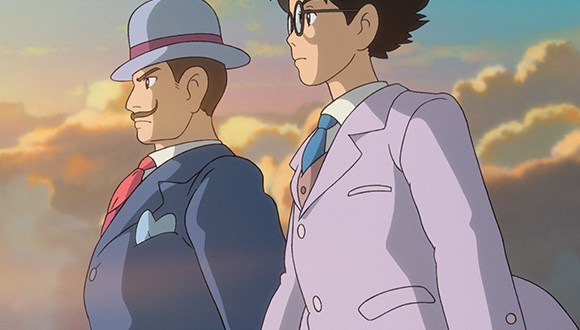
The Wind Rises is ostensibly the biography of Jiro Horikoshi, a pioneering aeronautical engineer who was responsible for designing the Mitsubishi A6M Zero Fighter used by the Japanese Navy throughout the Second World War. Although a real historical figure, Miyazaki presents Jiro as a Harry Potterish everyman and tweaks his life story to accommodate his own preoccupations.

When Miyazaki was a child in the 1940s, his father and uncle owned an aviation company that made parts for the Zeros, ensuring that no one in the family was conscripted to fight. Planes appear everywhere in Miyazaki’s work: the ominous shadows passing over the city in Howl’s Moving Castle before an air raid; the possessed paper planes inSpirited Away; the young neighbour’s toy plane in My Neighbour Totoro. And then there’s Porco Rosso, which is about a pig who is a bounty hunter and pilot. There are almost as many planes in that film as there are people.

The Wind Rises begins with a plane. We first meet Jiro as a sleeping child. In his dream, he climbs up onto the roof of his house and gets into a plane with feather-tipped wings, rising up vertically with perfect dream logic. But up there, in the sky, are monsters, loitering on bombs like the shadowy pilots in Howl’s Moving Castle. Jiro falls and lands… in reality.

He has woken up. The mosquito netting around him is blurred. He puts on his glasses and the room comes into focus. Here we are introduced to one of the most surprising elements of Miyazaki’s final film: it is set in the real world. His final challenge to himself has been to create a film without strange creatures or transformative curses. This world is governed by normal physics, so much so that the (animated, fictitious) camera has a depth of field and is susceptible to lens flare. Many of Jiro’s conversations concern the precise aerodynamics of the plane he’s designing. We see drawing board diagrams and designs in other Miyazaki films such as Porco Rosso and Totoro, yet in The Wind Risesthere is a new attention to physical reality. We watch over Jiro’s shoulder, like a supervisor, as he notes down the calculations on his slide-rule.

Jiro is an underdog, determined to make a plane to rival the industrial powerhouses to the West, despite Japan’s poor resources. Through his nightly dreams, and days of hard work at his desk, he renders a whole new reality. It couldn’t be a more literal analogy for Miyazaki’s work. Later, the engineer marries a painter—another fitting metaphor. The film is full of painterly skies and sunlit fields, sea and mountains. We see a cherry tree blossoming, moths gathering around lamps, the smoke from a cigarette or a cold breath curling into the air. We watch dappled light move over Jiro’s body on a woodland walk, and even see the shadows of objects offscreen, the silhouette of an unseen tree running across the floor and up the side of a building.

There are no serious antagonists in The Wind Rises. The most important relationship in the film is the love affair between Jiro and Naoko. When she was a child, Jiro saved her and her nanny from the chaos of an earthquake, carrying them from a railroad as burning detritus blew overhead from the city. Now she is a beautiful woman, Claude Monet’s Woman with a Parasol come to life, and she has found him—but, like the mother in My Neighbour Totoro, she has tuberculosis. Jiro and Naoko love each other devotedly, and decide to marry despite her being almost bed-bound, and his being wanted by the interior ministry. It would be hard not to smile at their courtship, watching them throw paper planes onto each other’s balcony, or make youthful declarations to one another.

The central conflict in the film comes from the plane itself. It is the perfect meeting point of the opposing forces that shape Miyazaki’s attitude towards technology: freedom and destruction, one sometimes necessitating the other. In Princess Mononoke, which echoes the earlier film Nausicaä of the Valley of the Wind, Ashitaka fights against a human society obsessed with building ever more efficient guns. Miyazaki is always careful to show how technology consumes. The candle that powers the steam boat in Ponyo runs outand there is a constant stream of coal in Kamaji’s boiler room in Spirited Away. Technology can also, sometimes, provide us with a seemingly limitless freedom, captured so well by his vehicles: the magic Cheshire Cat bus in My Neighbour Totoro, which bounds across landscapes in an instant, or the famous moving castle whose doors open onto different cities. In The Wind Rises, the plane embodies all of these qualities at once, belching exhaust fumes, describing perfect ellipses in the sky. It can kill even as it fulfils one of humanity’s great dreams, to fly among the clouds.

Some critics, both in Japan and in America, have criticised the film for supposedly glorifying Horikoshi’s contribution to the war. In fact, Jiro suggests during a design briefing that they remove the guns and, at one point, even finds himself strolling through the wreckages of crashed Zero fighters. If the film had come on any stronger with its anti-war message, it would have been patronising. Perhaps the criticism stems from the claim by Jiro’s role model, Caproni, that “aeroplanes are beautiful dreams.” The criticism is presumably that we mustn’t gloss over the brutal devastation of war; that every film set during a war should strive to imitate Schindler’s List. But in Miyazaki’s work, no one sets out to do evil, even if the result creates conflict. In Princess Mononoke, the humans are not making guns because they are malicious, but to protect the vulnerable and their livelihood. Every character is simply trying to further their own cause, or to perfect what they already do well. If only Jiro would play the villain, we could all condemn him, refuse to understand why he lived the way he did, and learn nothing.

Jiro is certainly not perfect, and his dogged quest to produce something beautiful puts a strain on his relationships with those around him. Caproni understands this impulse perfectly. He has been a kind of spirit guide through the film for Jiro, and ends by reassuring him that his work is over, and that “artists are only creative for ten years.” All that remains is to be grateful for the time that he had.

Miyazaki has been making films for far longer, of course, and his most recent have been among his best. It seems hard to believe that he will retire now. He is getting older, of course, and his artistic process is immensely demanding. But the real clue as to why Miyazaki has declared The Wind Rises his last film may lie in his childhood.

In 1945, when Miyazaki was four, the city where he lived with his father the aeroplane engineer, was bombed. The family was evacuated to a railway bridge. The sky was pink with flame. They got hold of a truck and, as they escaped the city, a woman and a child asked for a lift. But Miyazaki’s family drove on without stopping. It was an apparent failure of kindness, and he wondered later if it could have happened differently. Soon after the war ended, his mother contracted spinal tuberculosis, and underwent treatment for the next eight years.

Watching The Wind Rises, it feels as though this is the story Miyazaki has been coming round to all these years—the final, realist vision to resolve all those recurring images of planes, burning skies, the woman and child in need, the debilitating tuberculosis of a loved one. Over three decades, this raw material has provided fuel for his gorgeous fantasy. Now, at last, it has been transformed back into reality.