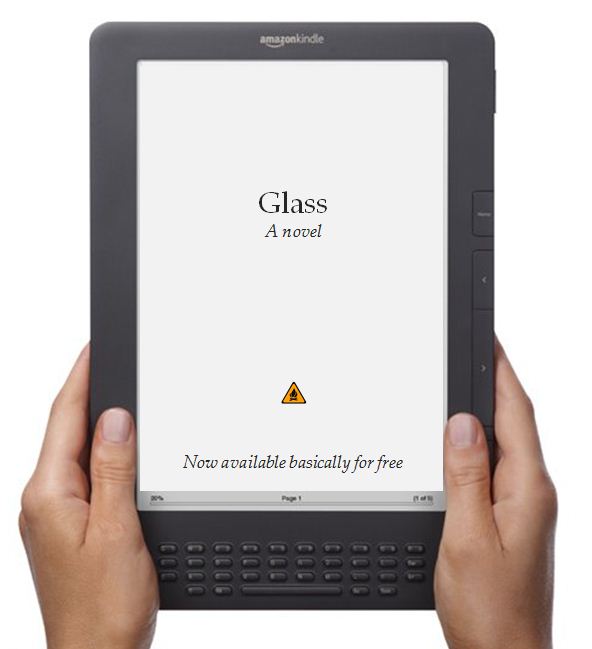
Amazon: your local library?

glassThe Kindle is everywhere. In the weeks leading up to Christmas last year, Amazon boasted that they were selling over a million per week. The e-commerce giant has been “introducing” them on their homepage for so long that I’m beginning to wonder when might be a polite time to interject that we’ve already met. As I write this piece, my Amazon homepage introduces the Kindle Family: the Kindle, Kindle Touch and Kindle Touch 3G. Other customers are apparently also looking at the Kindle Keyboard 3G with Free 3G + Wi-Fi, the Kindle with Wi-Fi and 6″ E Ink Display, and Veet for Men Hair Removal Gel Crème. Something for everyone, then.

Amazon was founded as a bookseller, but it became more successful than any of its competitors because it removed something previously thought of as crucial to bookselling, which was the bookshop. Instead they posted your book directly from their warehouse, which you could then open like a little present in the comfort of your own home.

For Amazon’s next trick, they removed an element which many regarded as a defining feature of the book, namely the codex itself. With ebook technology available but no one else willing to invest in developing the market, Amazon was like a (very businesslike and non-violent) wolf among sheep. Both heavy investment in the technology of their own-brand Kindle device and its unbeatable retail price gave them a de facto monopoly, particularly in Britain, where the competitive Nook isn’t being sold.

Now, it looks as if they are putting the infrastructure in place to make another seismic shift—from ownership to access. As well as Amazon Cloud Drive which, like Apple’s iCloud, lets you store the files you’ve bought securely online, they have created the Lending Library—a name which evokes nostalgic, homely images. They already have over 100,000 books on their digital shelves, and if you’re part of the scheme you can borrow one a month, with no overdue charges and no need to worry about whether you’ll have to join a three year waiting list to borrow the latest Game of Thrones.

The catch is that, unlike your friendly local library, it is not available for all comers. At the moment you have to be a US customer, and you also have to be subscribed to their Amazon Prime service, which will set you back $79 a year. If you do borrow a book by George RR Martin, he will get a tiny royalty. So you pay a flat subscription rate for access to content, and the owner of the intellectual property gets a smaller royalty than if you had bought it, because you never own the content. The Lending Library is beginning to look like a very familiar revenue model, one that is tremendously lucrative for the owner of the service, and less so for the owners of the content.

Except—and this is why I feel a vague sense of unease every time I land on the Amazon homepage—to qualify for the Lending Library, you have to be a Kindle device owner. At least Spotify have never tried to force you to buy a Spotify mp3 device. If I were the suspicious type, I might start to worry that, with its virtual monopoly on the ebook market, Amazon was trying to funnel my consumer behaviour into ever more proprietorial systems, designed to make owning and sharing harder and more expensive than if, for instance, I just went back to where it all started, and bought a physical book.

No-one has sold more physical or electronic books than Amazon in the past decade. For that, they have done the world a great service. But where musicians have tried to make up for declining record sales by making money from live music, authors have no direct analogue. So if Amazon loves books, I hope it remembers its roots and continues to sell them, because this isn’t quite the replacement for our local libraries that I had envisioned.

Habibi

habibiAt 35, Craig Thompson has already written three previous books: Goodbye, Chunky Rice, Blankets and Carnet de Voyage. But it was Blankets that propelled Thompson’s reputation as one of the leading lights in comics. Weighing in at around 600 pages, it was a major work that received widespread acclaim from both the comics and the mainstream worlds, and still sells well alongside the greats like Joe Sacco and Chris Ware.

With his new book, Habibi, he’s moved from comics publishers Top Shelf to mainstream trade publishers Faber, and although they are known much better for their poetry and literary fiction lists, they’ve pulled out all the stops with this. It’s an incredibly beautiful book, a real weighty tome, with careful attention to detail and high production values. They’ve taken a lot of the meticulous design that went into Thompson’s illustration and integrated it with the cover and endpapers, making a beautiful object of it.

It’s just as long as Blankets, which might explain how it’s taken him so long to write. In a 2004 interview, Thompson originally said he’d try and get it completed by 2005. Seven years on, it’s easy to see where the time went: not just in the sheer length of the work, which is frankly epic by graphic novel standards, but in the research, the beautiful Arabic calligraphy, the interweaving of various religious texts and tales in between the main love story and in the incredible attention to detail, describing the intricate patterns and textures of his world. It is a real visual feast, with a fluent, quick plot but pages that you could stare at for minutes at a time.

At the heart of this book, like his previous, is an unusual love story. We follow Dodola, a young slave girl who flees her captors with a baby called Zam, bringing her up on a strangely abandoned boat in the middle of the desert. As they grow up, they can’t keep the world around them from encroaching. Eventually Dodola is recaptured while Zam is out collecting water and we read on, desperately hoping they will be reunited.

The book draws on the Thousand And One Nights with Dodola as the Scheherazade figure, storytelling often to put off her own death, to divert the attention of men and boys and guarantee her own safety. The preciousness of water and words reminds me a little of Salman Rushdie and his children’s book Haroun and the Sea of Stories, weaving in a rich tapestry of sources. Thompson pulls in stories from both the Bible and the Qu’ran, carefully throwing up the commonality of the Abrahamic religions. Of course, religion was writ large in Blankets, but in Habibi, rather than smothering the action, it provides a source of inspiration, wisdom and comfort.

The setting is in a fictional Middle Eastern state, far removed from Thompson’s own world. He knows what he’s doing but someone who has always lived in America is always going to fight accusations of Orientalism. For my part, I think he’s got away with it, but he’s treading a very fine line. I suppose the reason it works for me is that, whilst he plays around with the myth and magic of the Orient, we’re never asked to believe wholeheartedly in the charms and djinns that crop up in the book. In fact, having convinced half the desert that she is an evil djinn, the real tragedy is that the Sultan wants to believe her. He captures her for his hareem, expecting her to live up to the rumours of fiery curses and flashing eyes, but she disappoints. ‘I wanted to believe such things,’ the Sultan says. ‘Instead you’re only human.’

I think when an author has worked on a book for so long, and delivered such a huge work, it’s tempting not to hold them to their errors. It seems petty and ungenerous to keep too close an eye on the author’s individual choices, as if you’re complaining about the size of your dessert spoon at a banquet. But there are a couple of serious errors of judgment here, including the jarring use of the word ‘honkeys’ and an unexplained Cheshire cat during an opium scene. The problem with graphic novels is that, once the author’s got cracking, they’re on their own. No editor can save them from their idiosyncrasies.

That said, Habibi is an incredibly rich and complex story. It’s wildly ambitious and could easily have fallen flat in the telling, but here it is, a modern fairy tale that already feels oddly timeless. Blankets was subtitled ‘an illustrated novel’ and that’s the feeling that I get from this book, too. Habibi reads first and foremost like a novel, and it happens to be told in the language of comics, pushing out the boundaries of the form. If you’re interested in what a serious modern graphic novel can do, this is required reading.

Gimme shelter

Survival guides always sell well in the USA. Perhaps it is part of the frontier mentality: one man, possibly holding a gun, protecting his family and his patch of soil. Or perhaps it is the Protestant obsession with linear narratives that end in a day of reckoning. Whatever it is, the idea that an honest US citizen might one day have to fend for himself, abandoned to the forces of nature immediately and without warning, is a persistent one.

In case you missed it, the current global financial crisis has repeatedly been referred to as a “perfect storm.” The storm metaphor is also evoked when talking about troubling mental disorders, as in the expression “black clouds,” used to describe depression. Put the three together, and you’ve got an American blockbuster movie.

In Take Shelter, one honest US citizen, who may or may not be mentally ill, is worrying about money, and about whether a massive storm is going to come and wipe out his family. The storm may be literal or metaphorical, the manifestation of a mental illness or a terrifying act of God. To hear the conceit, you could be forgiven for thinking that the film was going to be a bit trite, like one of those big-budget apocalypse films where New York taxis are flung into the Hudson and improbably strong children cling to lampposts. But, from the trailer, the film looked more pensive and brooding than all that, so I sat back and waited to be convinced.

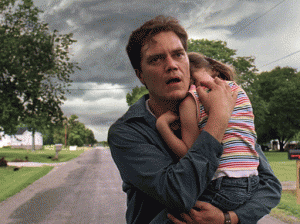
In the first shot, Curtis (Michael Shannon) stares out at a gathering storm. It looks like a real bastard of a storm: grey, sullen, unpredictable. The rain starts up heavily, lashing his face. We jump cut to Curtis in the shower. From that moment on, this is the theatre of battle. We are definitely watching a storm, and we don’t know whether it is Curtis turning on the tap. It’s a tension that plays out quietly, in unsettling increments.

Curtis is having terrible nightmares, but he doesn’t want to alarm his wife or daughter—his mother was diagnosed with paranoia at around the same age, and perhaps it really is nothing. Soon, the nightmares are troubling him deeply, affecting his work and home life, and his obsession with renovating the storm shelter out back is taking up ever more time and money. The heartbreaking paradox is that we don’t know whether, in trying to protect his family, he is really harming them further.

This is not a dialogue-heavy screenplay, but there’s enough talk to bring out some remarkable acting. Michael Shannon can glare in a way I haven’t seen since Ray Liotta, but he uses his arsenal sparingly, giving us a Curtis that is occasionally menacing, but often all too human, agonised, conscientious, trying his utmost to be self-contained. Jessica Chastain’s performance is assured, and their relationship with each other becomes very moving as you are drawn into their situation and the film builds towards its climax.

Take Shelter has been widely praised in the US, where it is already being hailed as a masterpiece. The film has failed to impress critics in the same way in the UK, but this is a very American film, tied up with concerns and a frame of reference that are American. We don’t live in a place where we lose our healthcare if we lose our job, and none of us (except the truly unhinged?) have even considered owning a storm shelter. But, on its own terms, it is a quietly affecting film that avoids blockbuster cliché and carefully builds to a powerful conclusion.